PROXIMITY SENSORS
A proximity sensor answers a simple question: is something there? The difficulty is that the answer depends on what the target is made of. Choose the wrong type and the sensor either misses the object or sees things it should ignore.
PART 3 OF 25 | 4 MIN READ | BY SUBODH RAJ
At a glance
| Sensor | Detects | Typical range | Best use |
|---|
| Inductive | Metals only | 1 to 40 mm | Metal parts on conveyors, machine tools |
| Capacitive | Almost anything, including liquids and powder | 3 to 30 mm | Level in hoppers, detecting through plastic walls |
| Magnetic / reed | A magnet on the moving part | Depends on magnet | Piston position in air cylinders, door alarms |
| Hall-effect | A magnet, with no moving parts | Short | Wheel speed, position, brushless motors |
A quick decision guide
- Counting steel components? Use inductive. It ignores plastic and dust and costs little.
- Checking if a bottle or box is full from outside? Use capacitive and set the sensitivity with the adjustment screw.
- Need the position of a pneumatic piston? Fit magnetic or reed sensors in the cylinder groove, since the piston already carries a magnet.
- Need a fast, long-life signal from a rotating part? Use Hall-effect, because it has no contacts to wear.
Things that catch people out
Inductive sensors have a reduction factor. Their rated range is for mild steel. Brass may give only about 40 percent of that distance, and copper or aluminium even less. Always check the manufacturer's factor table.
Capacitive sensors react to moisture and dirt on their face. If it is sensing a tank, a layer of product sticking to the wall can switch it permanently. A shielded version handles this better.
Reed switches have mechanical contacts. They handle low loads well but fail early on high inrush currents, so switch a relay, not a motor, with them.
Remember: Flush mounting matters. A flush (shielded) inductive sensor can sit in metal. A non-flush one needs free space around its face or it will trigger on its own housing.
The 7 sensors in this part
Each card below shows the sensor in use, what it is and how it works, and where you will find it.
SENSOR 1 OF 7
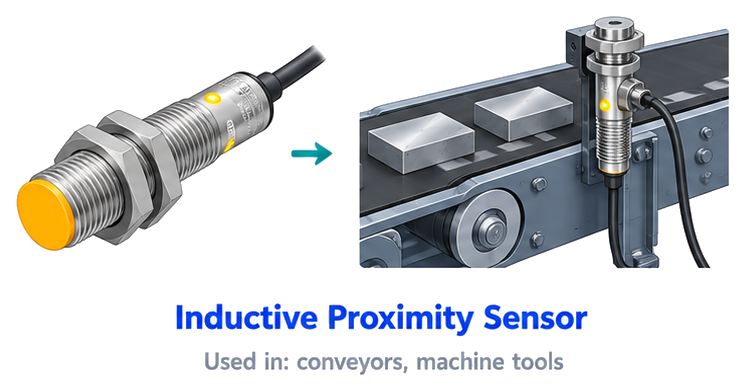
Inductive Proximity Sensor
An inductive proximity sensor detects metal objects without touching them. It creates a small high-frequency magnetic field in front of its face. When a metal object comes near, it disturbs this field, and the sensor switches its output. It has no moving parts, works in dirt and oil, and is very common in automation.
USED IN
conveyorsmachine tools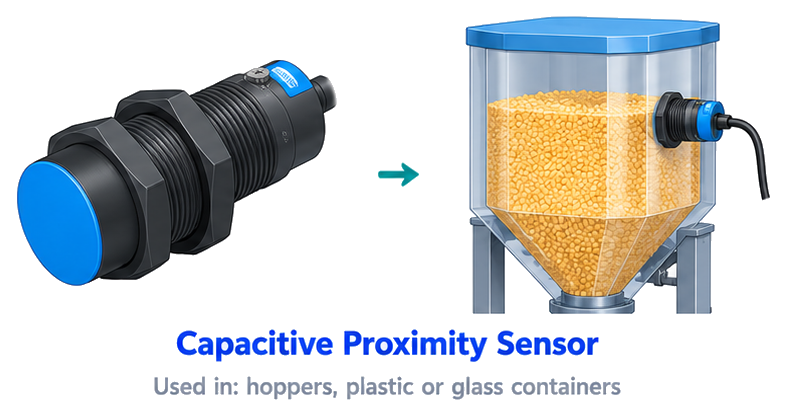
SENSOR 2 OF 7
Capacitive Proximity Sensor
A capacitive proximity sensor detects almost any material, such as plastic, glass, liquid, powder or metal. It creates an electric field in front of its face, and an object entering this field changes the capacitance. When the change is large enough, the output switches. It can also detect material through a thin wall of a container.
USED IN
hoppersplastic or glass containers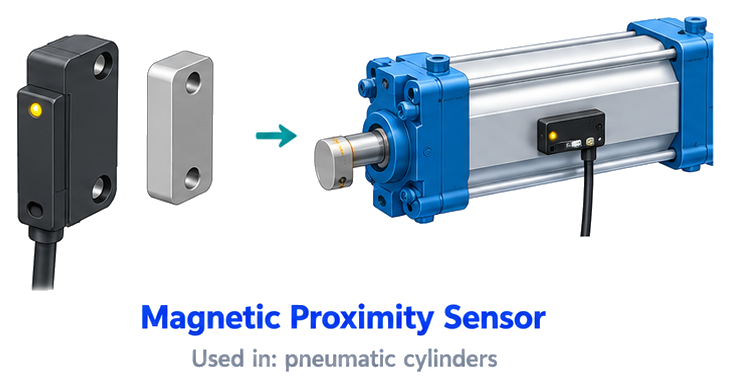
SENSOR 3 OF 7
Magnetic Proximity Sensor
A magnetic proximity sensor detects the presence of a magnet. A small magnet is fixed on the moving part, such as a piston, and the sensor is fixed on the body. When the magnet comes near, the sensor switches. It is the most common way to know the piston position inside a pneumatic cylinder.
USED IN
pneumatic cylinders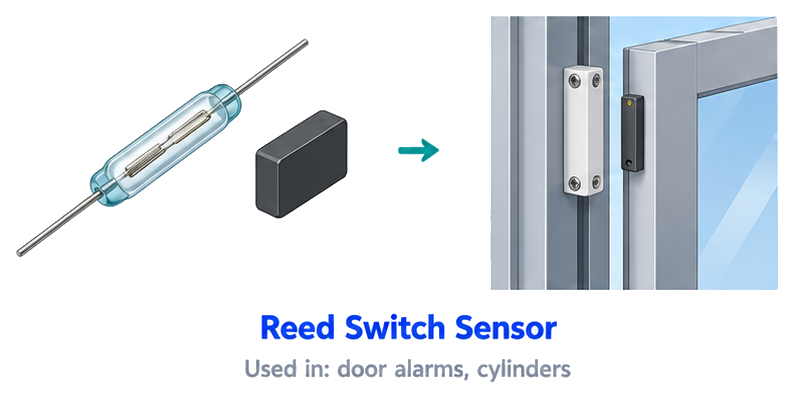
SENSOR 4 OF 7
Reed Switch Sensor
A reed switch sensor has two thin metal contacts sealed inside a glass tube. When a magnet comes near, the contacts attract each other and close the circuit. When the magnet moves away, the contacts open. It needs no power to operate, is small and simple, and is widely used for door alarms and cylinders.
USED IN
door alarmscylinders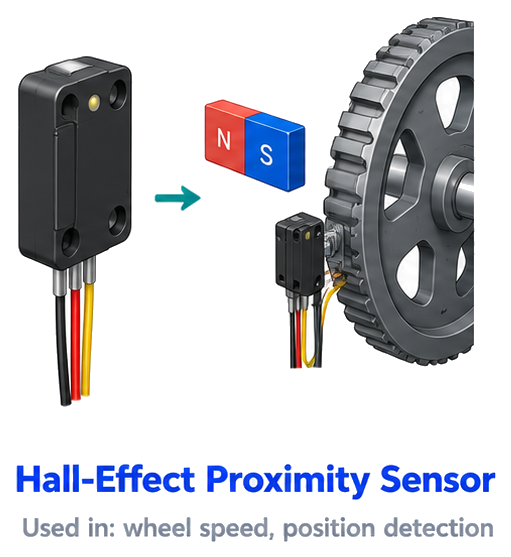
SENSOR 5 OF 7
Hall-Effect Proximity Sensor
A Hall-effect proximity sensor detects a magnet using a small semiconductor chip. When a magnetic field passes through the chip, a small voltage appears across it. The electronics turn this into a switching signal. It has no moving parts, is fast and long-lasting, and is used for position and speed detection.
USED IN
wheel speedposition detection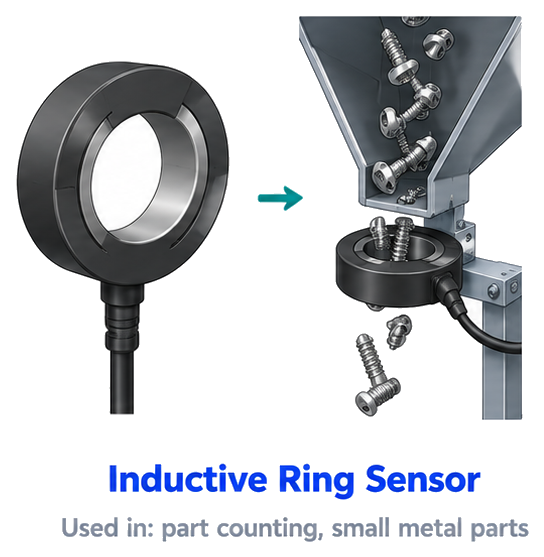
SENSOR 6 OF 7
Inductive Ring Sensor
An inductive ring sensor has a round opening, and the metal parts pass through the hole. A coil around the opening creates a magnetic field, and any metal part passing through changes it. The sensor then gives a pulse. It is used to count small metal parts such as screws, pins and rivets, and also to check that a part is present.
USED IN
part countingsmall metal parts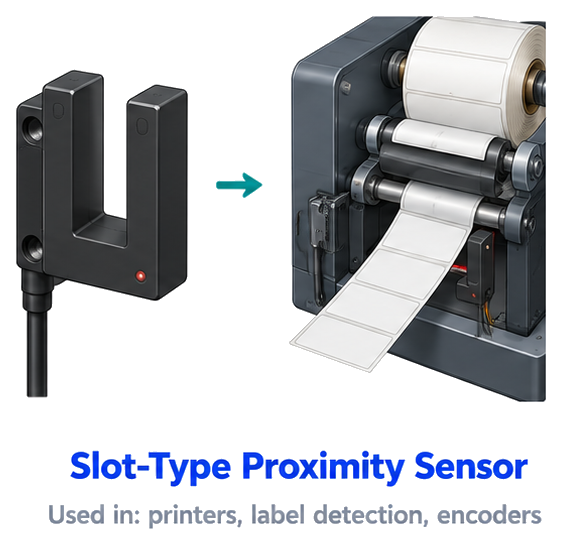
SENSOR 7 OF 7
Slot-Type Proximity Sensor
A slot-type proximity sensor has a U-shaped body with a light emitter on one arm and a receiver on the other. A light beam crosses the slot. When an object enters the slot and blocks the beam, the sensor changes its output. It is used for label detection, paper sensing, encoder discs and small part counting.
USED IN
printerslabel detectionencodersWant all 250+ sensors in one place?
The Master Sensor Handbook explains every sensor with its picture, definition and where it is used.
Buy the Master Sensor Handbook | INR 199Tap the button to message us on WhatsApp
Written by Subodh Raj,
EngineerX Academy. Part 3 of 25 in the Industrial Sensors series.
Comments
Post a Comment