TEMPERATURE SENSORS
At 2:10 a.m. the control room screen said the boiler outlet was steady at 180°C. The operator, Ravi, did not trust it. The steam felt hotter than that. He was right, and the next hour taught the whole shift something about temperature sensors.
PART 1 OF 25 | 4 MIN READ | BY SUBODH RAJ
What actually went wrong
The boiler used a thermocouple, which is a fair choice for high temperature. But a maintenance team had replaced a damaged extension cable with ordinary copper wire. A thermocouple does not measure temperature at the tip alone. It measures the voltage difference between the hot tip and the point where the thermocouple wire ends. Plain copper wire moved that point, and the reading drifted by almost 30°C. The sensor was fine. The wiring changed the answer.
Remember: Lesson one: a thermocouple needs matching thermocouple wire or compensating cable all the way to the instrument. Type K needs type K.
Why Ravi's plant used four different sensors
Walk through the same plant and you will find several temperature sensors, each chosen for a job.
| Sensor | Good at | Watch out for |
|---|
| RTD (PT100) | Accuracy and stability from about -200 to 600°C | Slower and costlier than a thermocouple |
| Thermocouple | Very high temperature (type K to about 1200°C), fast, cheap | Lower accuracy, needs correct wire, drifts with age |
| Thermistor | Small and very sensitive over a short range | Non-linear, usually limited to about 150°C |
| Infrared | No contact, moving or hazardous targets | Surface emissivity changes the reading |
The second problem: the thermowell
After fixing the cable, Ravi noticed the reading still lagged behind real changes. The probe sat inside a thick thermowell, which protects the sensor from pressure and flow but adds a delay because heat must travel through metal first. For slow processes this is fine. For fast control loops, a thinner well or a sheathed probe with a better contact makes the response much quicker.
Four questions to ask before you pick
- What is the maximum and normal temperature? Match the sensor range, not just the maximum.
- How accurate must it be? Billing and quality jobs need an RTD. Alarms can live with a thermocouple.
- How fast must it respond? Bare sheathed probes respond faster than probes in wells.
- Can you touch the target? If not, use infrared and set the correct emissivity.
Ravi's boiler was corrected by 3 a.m. The reading on screen matched the steam again. The real fix, though, was a short rule written on the maintenance board: sensor wire is part of the sensor.
The 9 sensors in this part
Each card below shows the sensor in use, what it is and how it works, and where you will find it.
SENSOR 1 OF 9
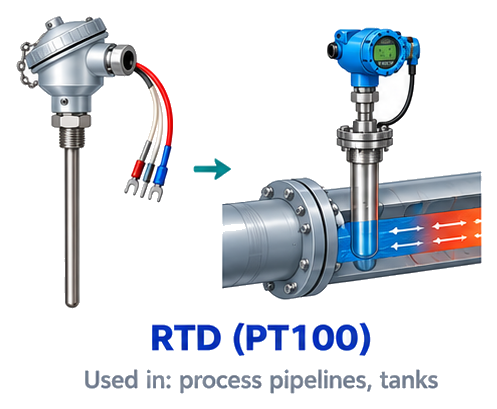
RTD (PT100)
An RTD (Resistance Temperature Detector) is a sensor that measures temperature using a thin platinum wire. When the temperature goes up, the resistance of the wire goes up in a fixed, known way. The controller reads this resistance and converts it into a temperature. PT100 means 100 ohms at 0°C. It is very accurate and stays stable for years.
USED IN
process pipelinestanks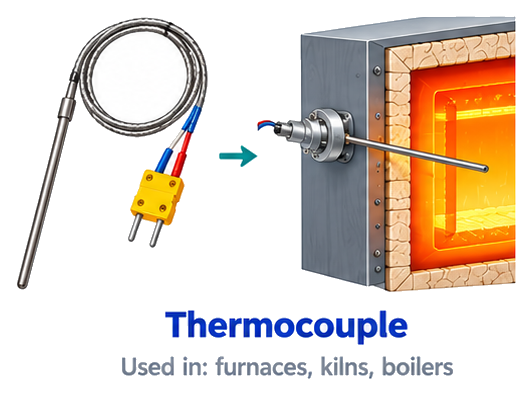
SENSOR 2 OF 9
Thermocouple
A thermocouple is made of two different metal wires joined together at one tip, called the hot junction. When this tip is heated, a tiny voltage is produced, and the voltage changes with temperature. It works over a very wide range, from very low to over 1000°C. It is rugged, cheap and fast, but less accurate than an RTD.
USED IN
furnaceskilnsboilers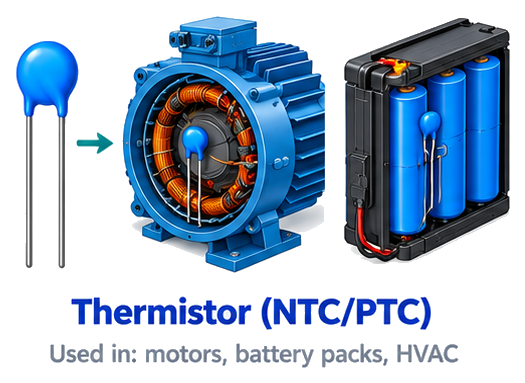
SENSOR 3 OF 9
Thermistor (NTC/PTC)
A thermistor is a small resistor made of ceramic material whose resistance changes quickly with temperature. In an NTC thermistor the resistance goes down when it gets hot. In a PTC thermistor the resistance goes up when it gets hot. It is small, cheap and very sensitive, so it is widely used for protection and simple temperature measurement.
USED IN
motorsbattery packsHVAC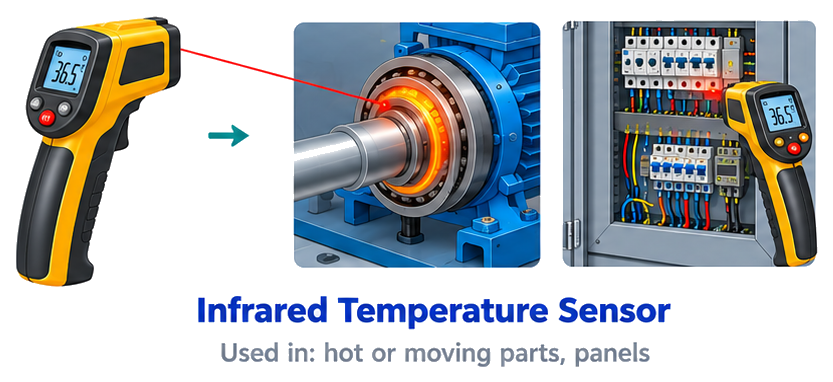
SENSOR 4 OF 9
Infrared Temperature Sensor
An infrared temperature sensor measures temperature without touching the object. Every hot object gives out invisible infrared rays. The sensor catches these rays with a lens and a detector and converts them into a temperature value. It is useful for objects that are moving, very hot, dangerous to touch or hard to reach.
USED IN
hot or moving partspanels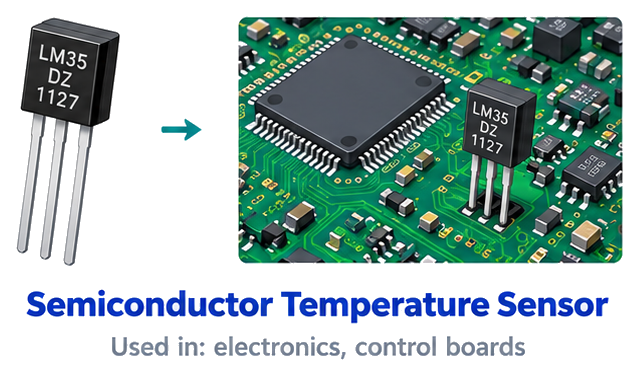
SENSOR 5 OF 9
Semiconductor Temperature Sensor
A semiconductor temperature sensor is a tiny chip that gives an electrical output (voltage, current or digital data) depending on temperature. It uses the way a silicon junction changes with heat. It is small, low cost and very easy to connect to electronic circuits, but it works only in a limited temperature range.
USED IN
electronicscontrol boards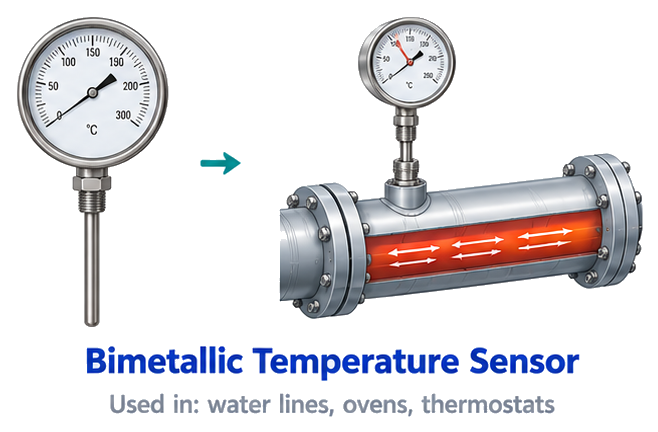
SENSOR 6 OF 9
Bimetallic Temperature Sensor
A bimetallic temperature sensor has two different metals bonded together as one strip. Both metals expand by different amounts when heated, so the strip bends. This bending moves a pointer on a dial or operates a switch. It needs no power supply, so it is simple and reliable for local indication and thermostats.
USED IN
water linesovensthermostats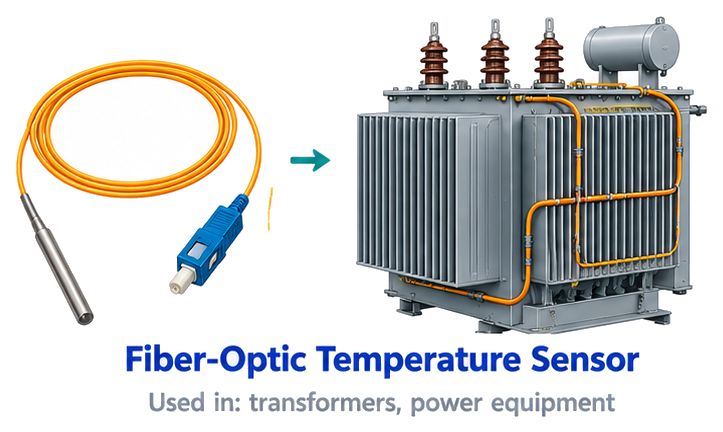
SENSOR 7 OF 9
Fiber-Optic Temperature Sensor
A fiber-optic temperature sensor uses a thin glass fibre to carry light to a sensing tip. The properties of the light coming back change with temperature, and the instrument reads this change. Because it has no metal and no electricity at the tip, it is not affected by electrical noise, high voltage or strong magnetic fields.
USED IN
transformerspower equipment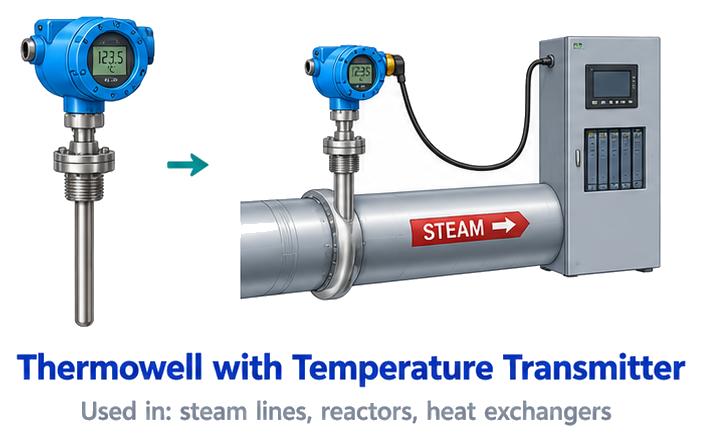
SENSOR 8 OF 9
Thermowell with Temperature Transmitter
A thermowell is a closed metal tube fitted into a pipe or tank, and the temperature probe sits inside it. It protects the probe from pressure, flow and chemicals, and lets the probe be removed without stopping the process. A temperature transmitter on top converts the probe signal into a standard 4-20 mA signal for the control room.
USED IN
steam linesreactorsheat exchangers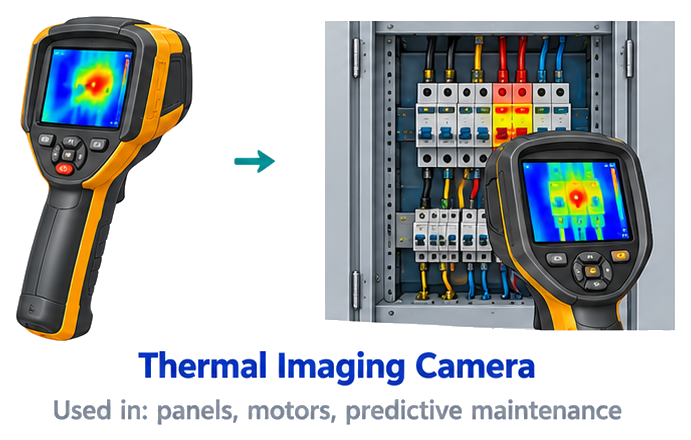
SENSOR 9 OF 9
Thermal Imaging Camera
A thermal imaging camera has a special detector that sees infrared heat instead of normal light. It shows the temperature of every point as a colour picture, so hot and cold areas are visible at a glance. It is used to find loose connections, overheating motors and heat loss without touching or stopping anything.
USED IN
panelsmotorspredictive maintenanceWant all 250+ sensors in one place?
The Master Sensor Handbook explains every sensor with its picture, definition and where it is used.
Buy the Master Sensor Handbook | INR 199Tap the button to message us on WhatsApp
Written by Subodh Raj,
EngineerX Academy. Part 1 of 25 in the Industrial Sensors series.
Comments
Post a Comment