Pressure Sensors Explained: 10 Questions Every Technician Asks
The 11 sensors in this part
Each card below shows the sensor in use, what it is and how it works, and where you will find it.
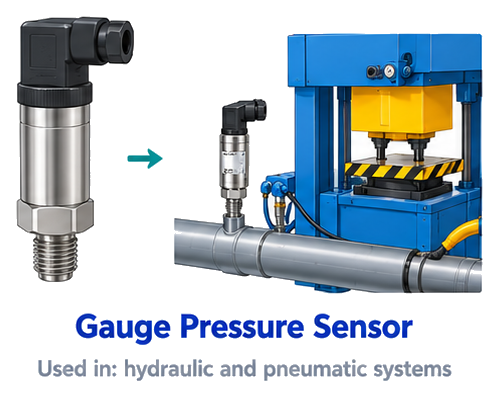
Gauge Pressure Sensor
A gauge pressure sensor measures pressure relative to the surrounding atmospheric pressure. A thin diaphragm bends with pressure, and the bend is converted into an electrical signal. When the sensor is open to air it reads zero. This is the most common type of pressure sensor, used in hydraulic, pneumatic and water systems.
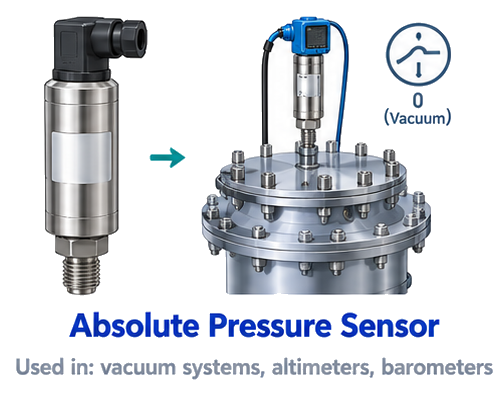
Absolute Pressure Sensor
An absolute pressure sensor measures pressure compared to a perfect vacuum, which is zero pressure. One side of its diaphragm is sealed with a vacuum reference. So its reading does not change with weather or altitude. It is used where the true pressure value matters, such as barometers, altimeters and vacuum processes.
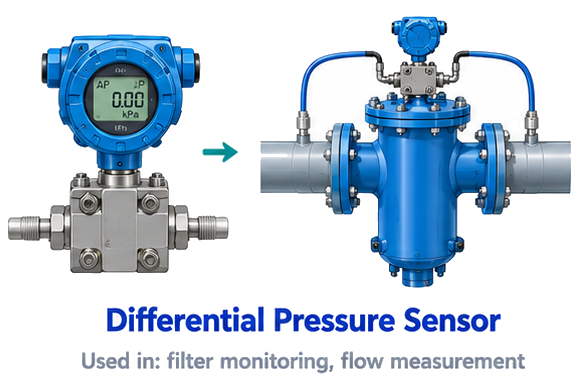
Differential Pressure Sensor
A differential pressure sensor measures the difference in pressure between two points. It has two ports, one on each side of a diaphragm. The diaphragm bends according to the difference, and this is converted into a signal. It is widely used to find a blocked filter, to measure flow across an orifice and to find level in closed tanks.
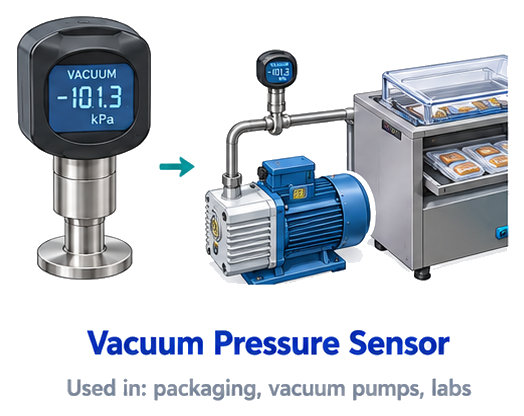
Vacuum Pressure Sensor
A vacuum pressure sensor measures very low pressure, below normal air pressure, inside a vacuum chamber or line. Different methods are used for different vacuum levels, such as thermal conduction (Pirani) or capacitive diaphragms. It is used in vacuum pumps, packaging machines, laboratories and semiconductor equipment.
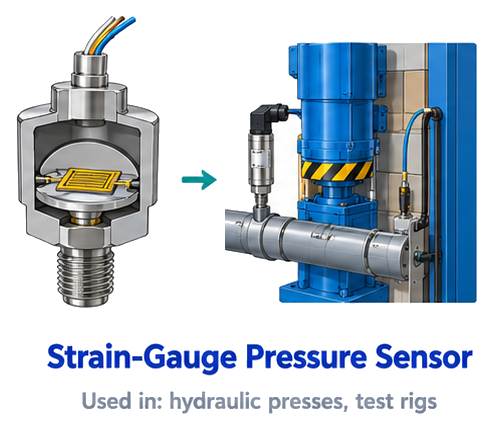
Strain-Gauge Pressure Sensor
A strain-gauge pressure sensor has a metal diaphragm with strain gauges bonded to it. When pressure bends the diaphragm, the gauges stretch or compress and their resistance changes slightly. A bridge circuit turns this into a voltage. It is robust, accurate and suitable for high pressure, so it is common in hydraulic and test applications.
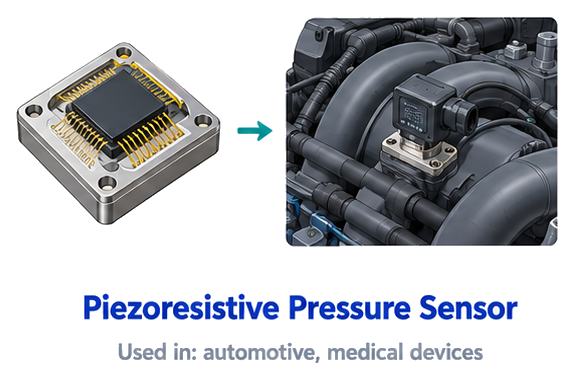
Piezoresistive Pressure Sensor
A piezoresistive pressure sensor has a silicon diaphragm with tiny resistors built into it. Pressure bends the silicon and changes the resistance of these resistors. This change is converted into a voltage signal. It is small, accurate and low cost, so it is widely used in automobiles, medical devices and industrial transmitters.
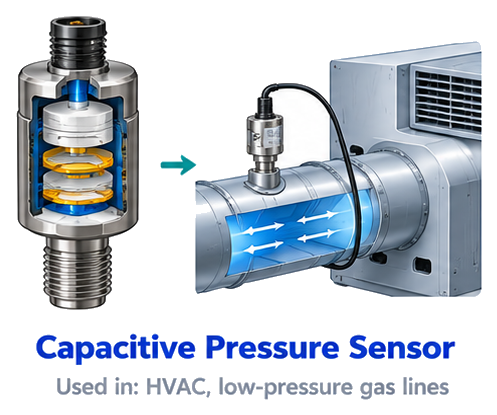
Capacitive Pressure Sensor
A capacitive pressure sensor has a thin diaphragm placed close to a fixed plate, forming a capacitor. When pressure pushes the diaphragm closer, the capacitance increases. The electronics measure this change and convert it to pressure. It is very sensitive at low pressure and has good stability, so it is used in HVAC and gas lines.
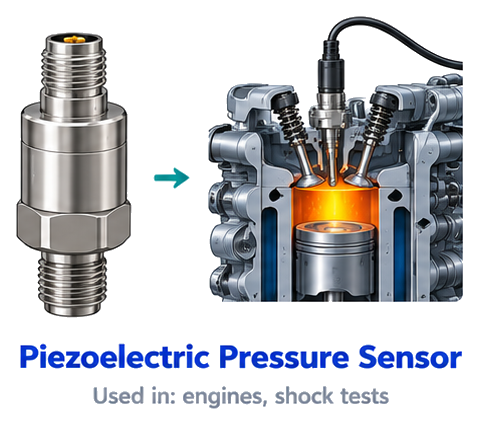
Piezoelectric Pressure Sensor
A piezoelectric pressure sensor uses a crystal, such as quartz, that produces an electric charge when it is squeezed. The charge is proportional to the pressure applied. It responds very fast, so it is ideal for rapidly changing pressure such as engine combustion, blasts and shock waves. It cannot measure steady pressure for long.
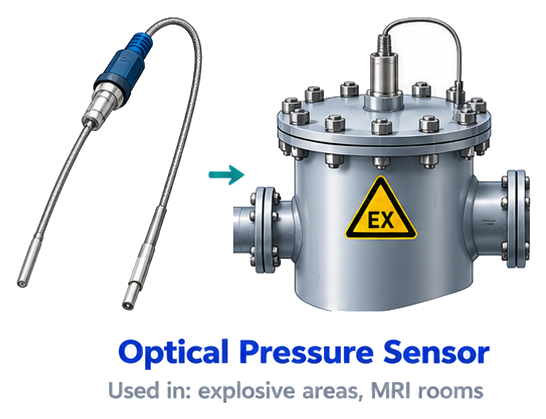
Optical Pressure Sensor
An optical pressure sensor uses light inside an optical fibre to measure pressure. The pressure changes a tiny diaphragm at the fibre tip, and this changes the light that returns. Because there is no electricity at the sensing point, it is safe in explosive areas and unaffected by magnetic fields, so it can be used in MRI rooms.
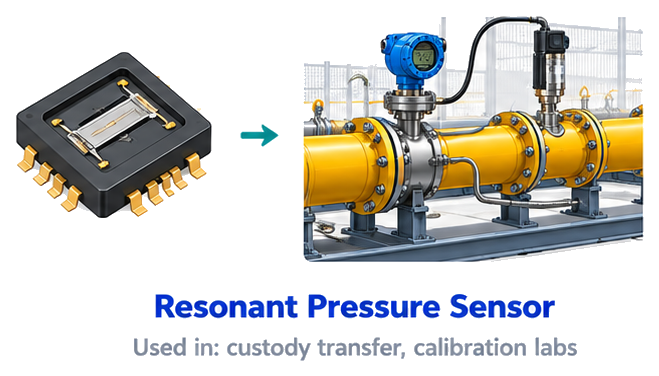
Resonant Pressure Sensor
A resonant pressure sensor has a tiny silicon beam that vibrates at its natural frequency. When pressure acts on it, the tension in the beam changes, and so does the vibration frequency. The electronics measure this frequency, which gives a very accurate and stable pressure reading. It is used where the highest accuracy is needed.
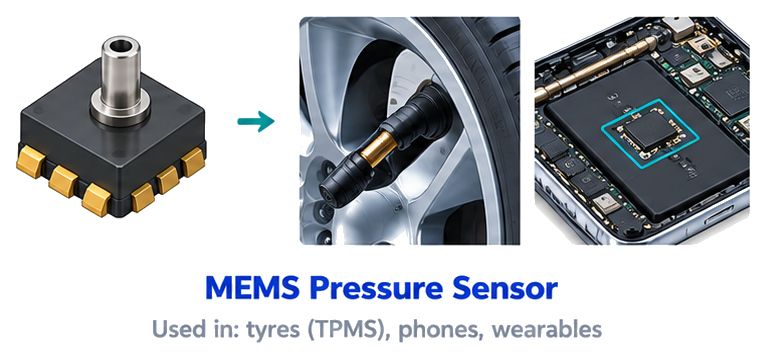
MEMS Pressure Sensor
A MEMS pressure sensor is a very tiny pressure sensor made on a silicon chip using micro-machining, the same technology as computer chips. It contains a micro diaphragm and electronics in one small package. It is low cost, light and low power, so it is used in tyres (TPMS), phones, drones and wearables.
- Get link
- X
- Other Apps
Comments
Post a Comment