IDENTIFICATION & TRACKING SENSORS
Every item that needs tracking carries a label of some sort. The best label depends on how much data you need, how far away you read, and what the surface is like.
PART 22 OF 25 | 4 MIN READ | BY SUBODH RAJ
Round 1: Data capacity
A 1D barcode holds a short number, like 12 to 20 characters. QR codes hold up to several thousand characters, including links. Data Matrix holds up to about 2,300 characters in a very small area. RFID tags hold from a few bytes to several kilobytes, and can be rewritten.
| Technology | Typical range | Line of sight needed |
|---|
| Barcode scanner | Contact to a few metres | Yes |
| QR / Data Matrix camera | Up to about a metre | Yes |
| NFC | A few centimetres | No |
| HF RFID (13.56 MHz) | Up to about 1 metre | No |
| UHF RFID | Several metres | No |
Round 3: Cost
Printed codes cost almost nothing. RFID tags cost more per item, so they pay back where speed, automation or reuse matters. Reader hardware is the larger cost in any system.
Round 4: Harsh environment
Data Matrix can be marked directly onto metal with lasers or dot-peen and survives paint and wear. RFID tags work through packaging and dirt, but metal and liquids detune them, and special on-metal tags are needed.
- OCR reads printed text like expiry dates, which saves printing a second code.
- Magnetic stripes are common in cards and tickets but wear out.
- Vision-based identification reads shape and markings when no code is allowed.
Who wins?
There is no single winner. Use printed codes for low-cost, line-of-sight needs, Data Matrix for part traceability, HF or NFC for access and secure short range, and UHF for pallets and warehouse flow.
The 10 sensors in this part
Each card below shows the sensor in use, what it is and how it works, and where you will find it.
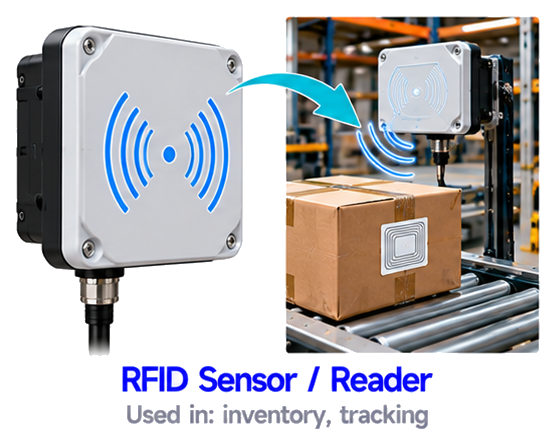
SENSOR 1 OF 10
RFID Sensor / Reader
An RFID sensor/reader uses radio waves to read data from small tags fixed on items. The tag does not need to be seen or touched, and many tags can be read quickly. It is used for inventory, tracking and access control.
USED IN
inventorytracking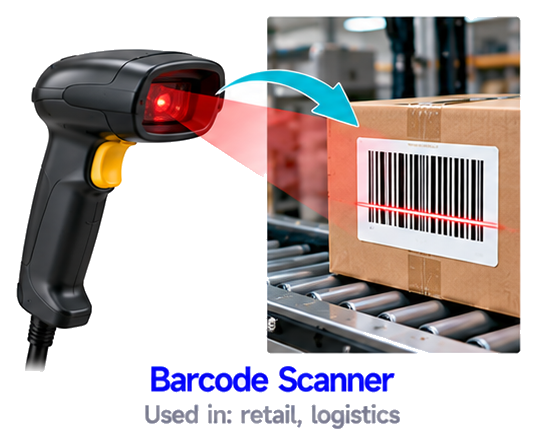
SENSOR 2 OF 10
Barcode Scanner
A barcode scanner reads the pattern of black and white bars of a barcode using a laser or camera. The pattern is converted to numbers that identify the product. It is fast and cheap and is used in retail, logistics and warehouses.
USED IN
retaillogistics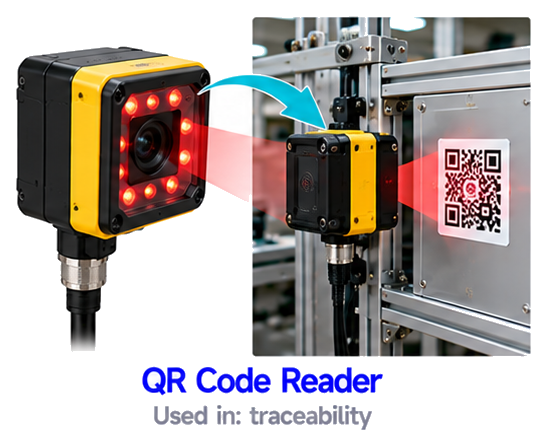
SENSOR 3 OF 10
QR Code Reader
A QR code reader uses a camera to read a square QR code. A QR code can store much more data than a barcode, including web links. It can be read from any angle, and it is used for tracking, traceability and product information.
USED IN
traceability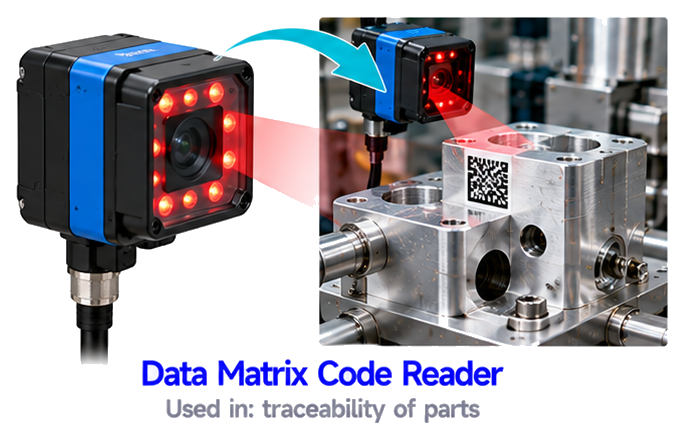
SENSOR 4 OF 10
Data Matrix Code Reader
A Data Matrix code reader reads small square codes made of tiny dots or squares. These codes can be very small and can be marked directly on metal or plastic parts. It is used in manufacturing for tracing parts through the production process.
USED IN
traceability of parts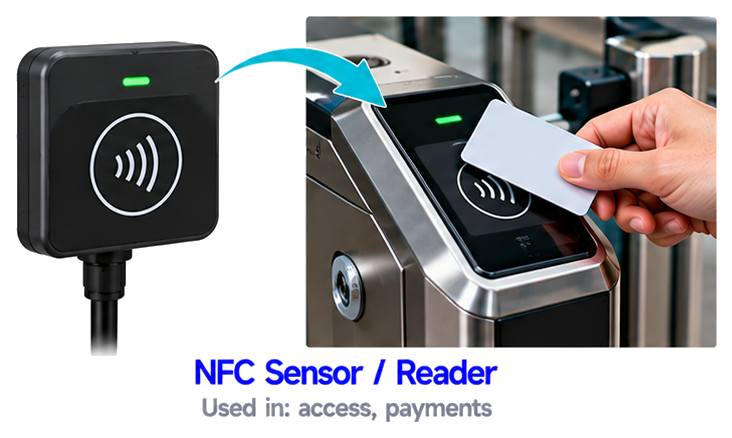
SENSOR 5 OF 10
NFC Sensor / Reader
An NFC (Near Field Communication) reader works over a very short distance, a few centimetres. It reads and writes data from a tag or phone by touching or tapping. It is used for contactless payments, access cards and quick pairing.
USED IN
accesspayments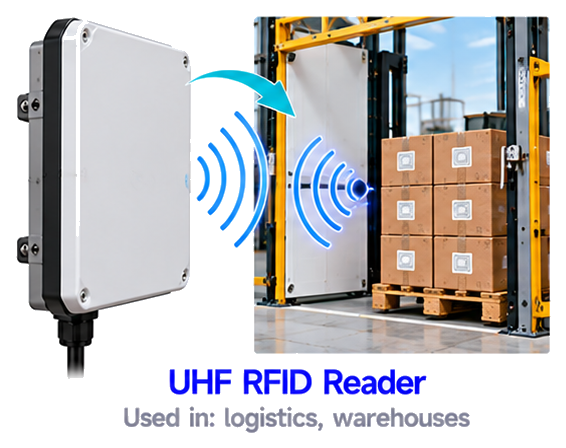
SENSOR 6 OF 10
UHF RFID Reader
A UHF RFID reader uses ultra-high-frequency radio waves and can read tags from several metres away. It can read many tags at the same time. It is used in logistics, warehouses and supply chains to track pallets and items quickly.
USED IN
logisticswarehouses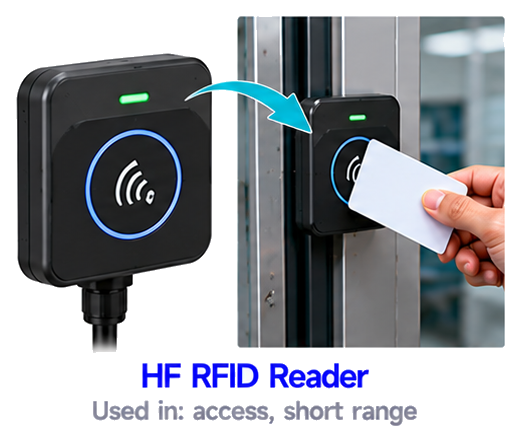
SENSOR 7 OF 10
HF RFID Reader
An HF RFID reader works at 13.56 MHz and reads tags at a short range, up to about a metre. It is reliable around people and common items. It is used for access cards, library books and short-range tracking.
USED IN
accessshort range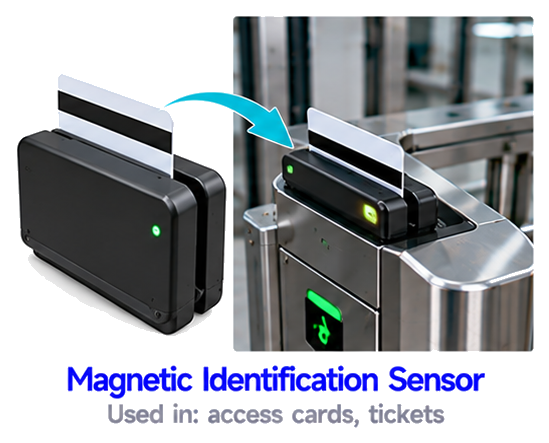
SENSOR 8 OF 10
Magnetic Identification Sensor
A magnetic identification sensor reads data stored in a magnetic strip, for example on a card or a ticket. When the strip is swiped past the reading head, the changing magnetism produces a signal. It is used for access cards, tickets and bank cards.
USED IN
access cardstickets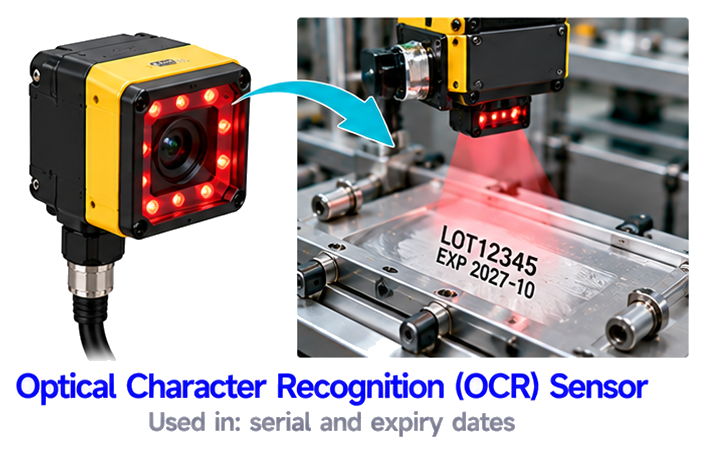
SENSOR 9 OF 10
Optical Character Recognition (OCR) Sensor
An optical character recognition (OCR) sensor reads printed letters and numbers using a camera and software. It reads text such as serial numbers and expiry dates, without needing a barcode. It is used to check printed information on products and packs.
USED IN
serial and expiry dates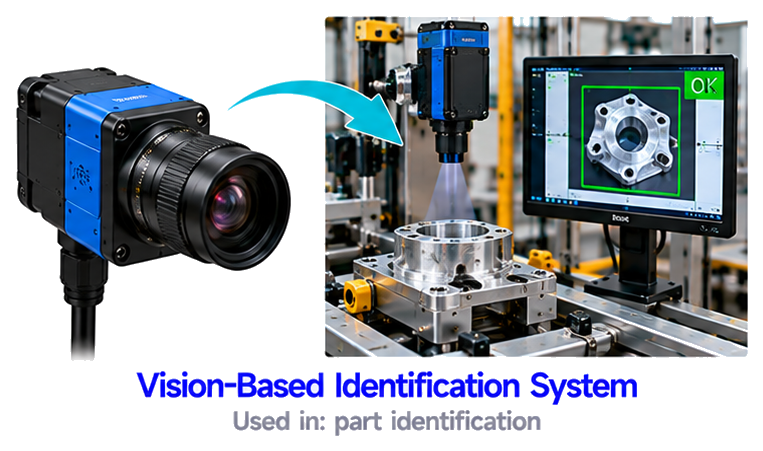
SENSOR 10 OF 10
Vision-Based Identification System
A vision-based identification system uses cameras and software to identify parts by their shape, size, colour or markings. It does not need a tag or a code. It is used to sort, check and identify parts on production lines.
USED IN
part identificationWant all 250+ sensors in one place?
The Master Sensor Handbook explains every sensor with its picture, definition and where it is used.
Buy the Master Sensor Handbook | INR 199Tap the button to message us on WhatsApp
Written by Subodh Raj,
EngineerX Academy. Part 22 of 25 in the Industrial Sensors series.
Comments
Post a Comment