ACOUSTIC & ULTRASONIC SENSORS
Early in my career a senior engineer walked past a compressor, stopped, and said 'that one is not happy'. I heard nothing. Years later I understood that machines tell you things in sound, and ultrasonic sensors extend that hearing far beyond what ears can do.
PART 20 OF 25 | 4 MIN READ | BY SUBODH RAJ
Ultrasonic distance, level and proximity sensors send a short sound burst and time the echo. Distance equals speed of sound times half the echo time. Sound travels about 343 m/s in air at 20°C, and the speed rises with temperature, so good sensors measure temperature too.
They work on clear plastic, liquids and coloured surfaces where optical sensors struggle. They struggle with soft foam, strong wind and heavy dust.
Ultrasound that listens
Leaking compressed air makes a hiss at 40 kHz, far above human hearing. An ultrasonic leak detector, with a directional head, finds leaks in noisy plants. In many plants, leaks waste a large share of compressor output, so the payback is quick.
Ultrasound that looks inside
Thickness gauges send a pulse into a metal wall and time the echo from the far side. That checks corrosion without cutting. NDT probes use the same idea with different angles to find cracks in welds.
Ultrasonic flow sensors time sound moving with and against the flow. The difference in travel time gives the speed of the liquid.
Sound that tells you about damage
Acoustic emission sensors listen for the tiny stress waves a crack makes while it grows. They give early warning on pressure vessels and pipes. A microphone with analysis software can learn the normal sound of a gearbox and flag a change.
Monitoring the weld
In ultrasonic plastic welding, a monitor records vibration energy, time and force for each weld, and rejects those outside the known good window.
Remember: Practical tip: couplant gel is not optional. Without it, air between the probe and the metal reflects the sound and you read nothing.
The 10 sensors in this part
Each card below shows the sensor in use, what it is and how it works, and where you will find it.
SENSOR 1 OF 10
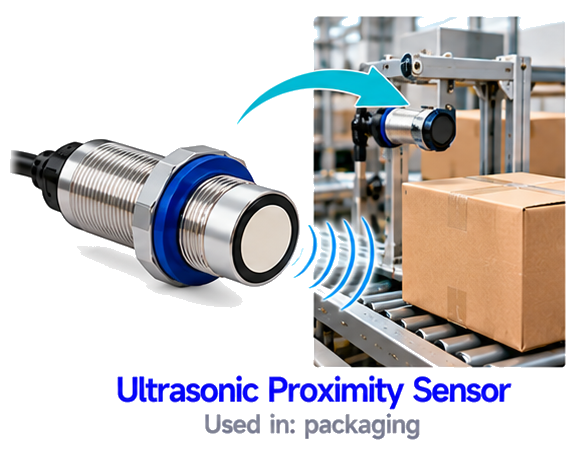
Ultrasonic Proximity Sensor
An ultrasonic proximity sensor sends ultrasonic sound and detects objects by the echo that returns from them. It can detect many materials, including transparent ones, and is not affected by colour. It is used to detect objects at a distance, such as on packaging lines.
USED IN
packaging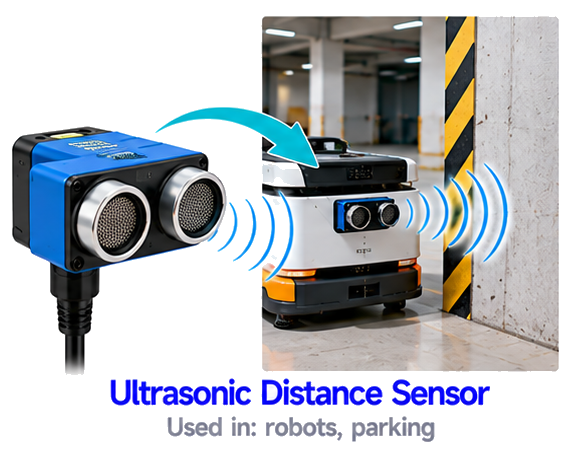
SENSOR 2 OF 10
Ultrasonic Distance Sensor
An ultrasonic distance sensor sends out a burst of ultrasound and measures how long the echo takes to return. The time is converted to the distance to the object. It is simple and low cost and is used in robots, parking aids and level measurement.
USED IN
robotsparking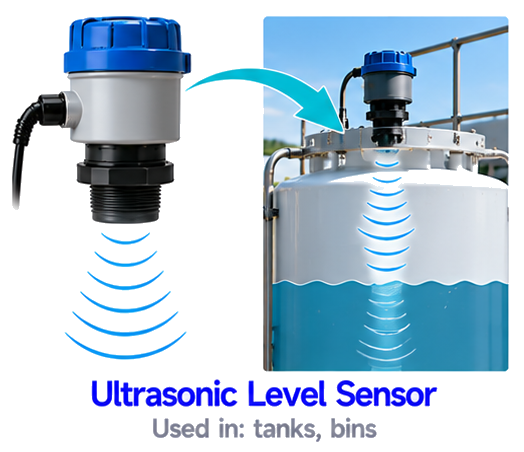
SENSOR 3 OF 10
Ultrasonic Level Sensor
An ultrasonic level sensor measures how full a tank or bin is. It sends sound toward the surface of the material and measures the time of the echo. From the distance to the surface, the level is calculated. It is non-contact and used for tanks and bins.
USED IN
tanksbins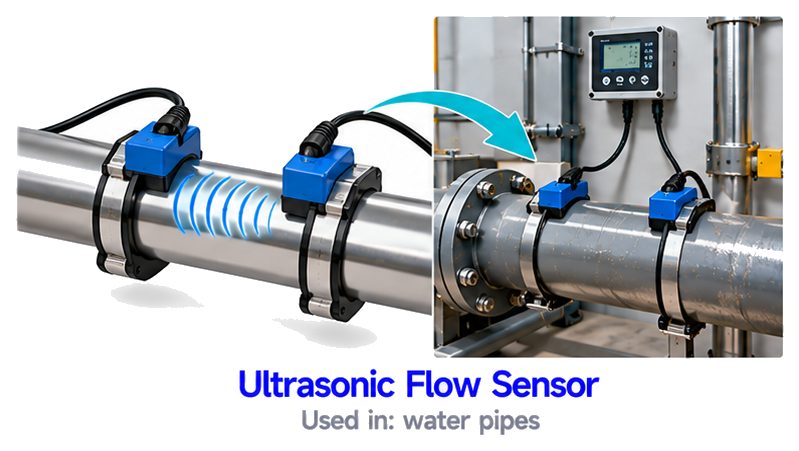
SENSOR 4 OF 10
Ultrasonic Flow Sensor
An ultrasonic flow sensor measures the speed of a liquid in a pipe using sound waves. In the transit-time method, pulses travel with and against the flow, and the time difference shows the speed. Clamp-on types fix on the outside of the pipe.
USED IN
water pipes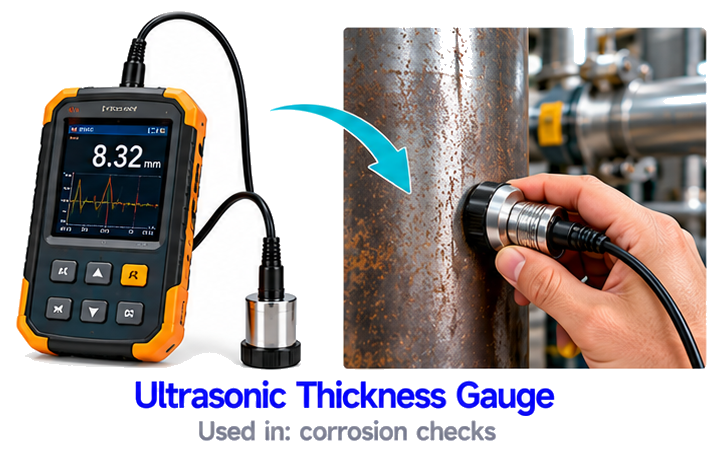
SENSOR 5 OF 10
Ultrasonic Thickness Gauge
An ultrasonic thickness gauge sends a sound pulse into a material from one side and measures the time for the echo from the opposite surface. The time gives the thickness. It is used to check wall thickness and corrosion in pipes, tanks and plates without cutting them.
USED IN
corrosion checks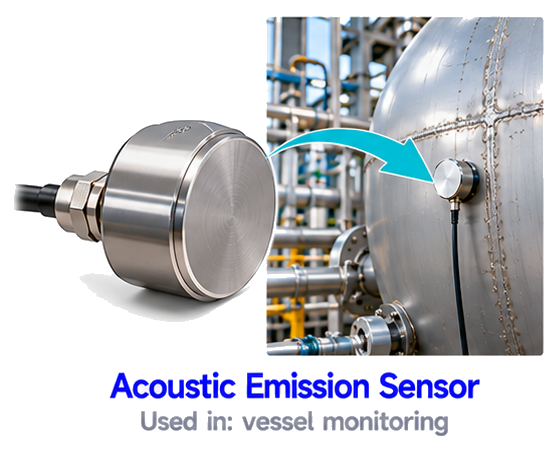
SENSOR 6 OF 10
Acoustic Emission Sensor
An acoustic emission sensor listens for the very small sound waves that are made inside a material when it is stressed, cracks or leaks. A piezoelectric element picks up these high-frequency signals. It is used for early warning of damage in pressure vessels, pipes and bridges.
USED IN
vessel monitoring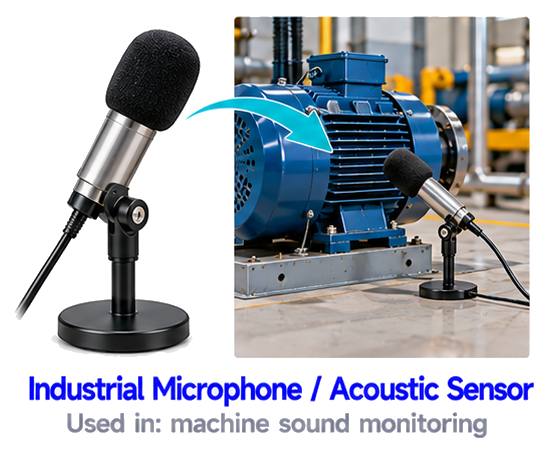
SENSOR 7 OF 10
Industrial Microphone / Acoustic Sensor
An industrial microphone or acoustic sensor picks up the sound of machines. A change in the sound, such as a new noise or louder level, can show a developing fault. It is used to monitor machines, gearboxes and for quality checks.
USED IN
machine sound monitoring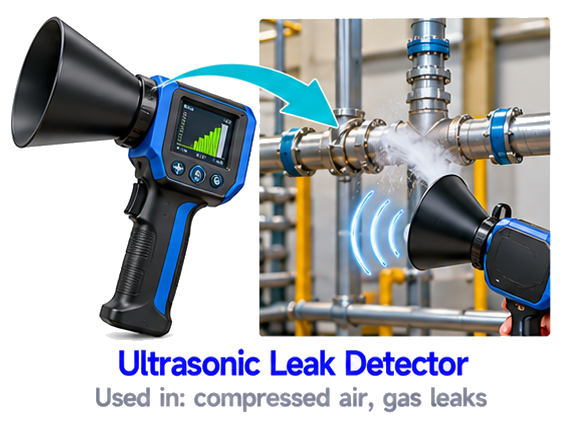
SENSOR 8 OF 10
Ultrasonic Leak Detector
An ultrasonic leak detector listens to the high-pitched sound made by gas or air escaping from a small leak, which humans cannot hear. It converts this to an audible sound or a display. It helps to find leaks in compressed air and gas systems quickly.
USED IN
compressed airgas leaks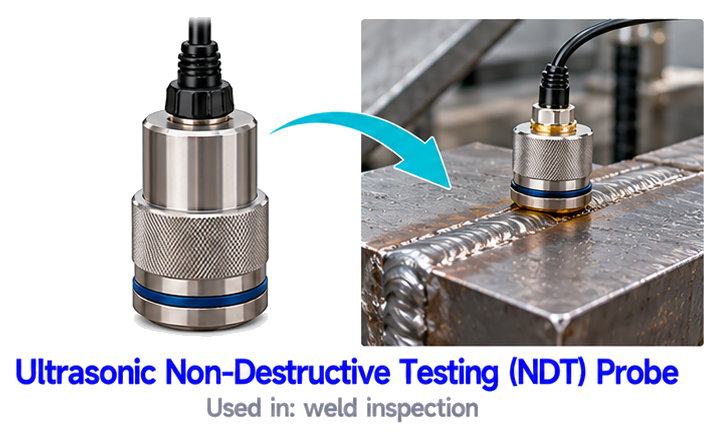
SENSOR 9 OF 10
Ultrasonic Non-Destructive Testing (NDT) Probe
An ultrasonic non-destructive testing (NDT) probe sends sound pulses into a material and listens for echoes. Hidden cracks, voids and defects reflect the sound, and these appear as signals. It checks welds and metal parts without damaging them.
USED IN
weld inspection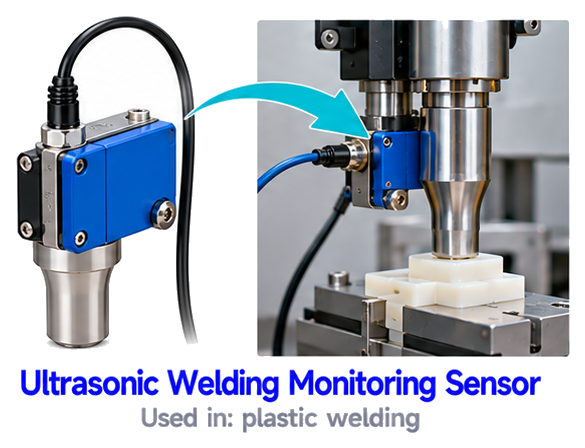
SENSOR 10 OF 10
Ultrasonic Welding Monitoring Sensor
An ultrasonic welding monitoring sensor watches the vibration, force and energy during ultrasonic welding. It compares them with good-weld values to check the weld quality. It helps ensure that every weld in plastic or metal parts is good.
USED IN
plastic weldingWant all 250+ sensors in one place?
The Master Sensor Handbook explains every sensor with its picture, definition and where it is used.
Buy the Master Sensor Handbook | INR 199Tap the button to message us on WhatsApp
Written by Subodh Raj,
EngineerX Academy. Part 20 of 25 in the Industrial Sensors series.
Comments
Post a Comment