POSITION DETECTION & MECHANICAL LIMIT SENSORS
A limit switch is the simplest sensor in a plant and the easiest to misapply. The right actuator makes it last for years. The wrong one breaks in weeks.
PART 15 OF 25 | 4 MIN READ | BY SUBODH RAJ
Pick by how the object arrives
| Actuator | Object arrives | Typical place |
|---|
| Plunger | Straight on, from the front | Presses, door stops |
| Roller plunger | Sliding across a cam | Machine tables |
| Roller lever | From the side, at an angle | Conveyors, cam tracks |
| Rotary lever | Swinging, sweeping movement | Gates, cranes |
| Fork lever | From either side, with latching | Two-way travel |
| Flexible rod (whisker) | Unpredictable positions | Conveyors with mixed boxes |
| Hinge-operated | Door or cover opening | Machine guards |
| Rotary (geared) | Many positions per turn | Hoists, cranes |
Why they are still used
- They switch real loads directly.
- Their action is visible and easy to test with a finger.
- They are insensitive to dirt, light and electrical noise.
- They carry safety approvals in positively driven versions.
- Do not use the switch as a hard stop. The machine should reach the limit with a gentle approach.
- Set the lever at the right angle so it travels most but not all of its stroke.
- Seal the cable entry. Water in the head is the most common failure.
Safety: For guard doors, use switches with positively driven contacts and a safety-rated design. An ordinary limit switch can fail in the closed position and hide the fault.
Pull-cord switches are a special group. A rope runs along a conveyor, and a pull anywhere stops the line. They are an emergency stop that can be reached from any point.
The 10 sensors in this part
Each card below shows the sensor in use, what it is and how it works, and where you will find it.
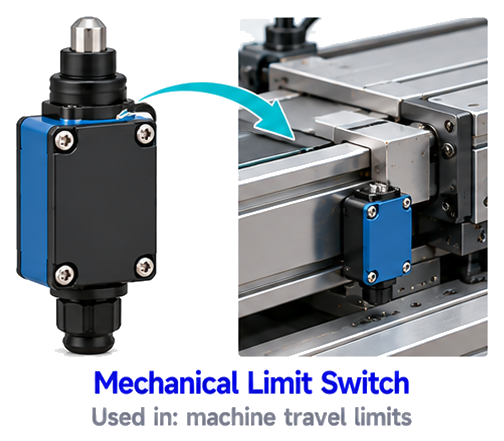
SENSOR 1 OF 10
Mechanical Limit Switch
A mechanical limit switch has an actuator that is pressed or moved by a part of the machine. This changes the electrical contacts inside, usually from open to closed or the reverse. It tells the control system that a travel limit has been reached, and it is simple and strong.
USED IN
machine travel limits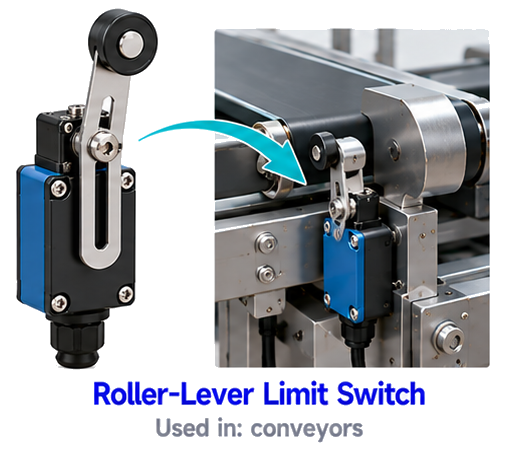
SENSOR 2 OF 10
Roller-Lever Limit Switch
A roller-lever limit switch has a lever with a roller at its end. A moving object or cam pushes against the roller, which turns the lever and operates the switch. The roller reduces wear, so it is used on conveyors and where parts slide past the switch.
USED IN
conveyors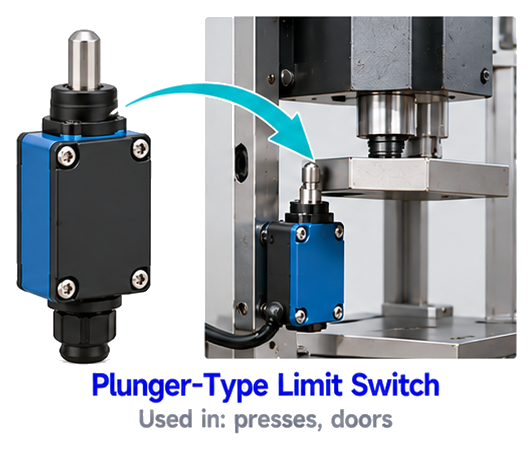
SENSOR 3 OF 10
Plunger-Type Limit Switch
A plunger-type limit switch has a small push rod (plunger) on top. When an object pushes straight down on the plunger, the contacts change. It is accurate and compact and is used where the object moves straight toward the switch, such as on presses and doors.
USED IN
pressesdoors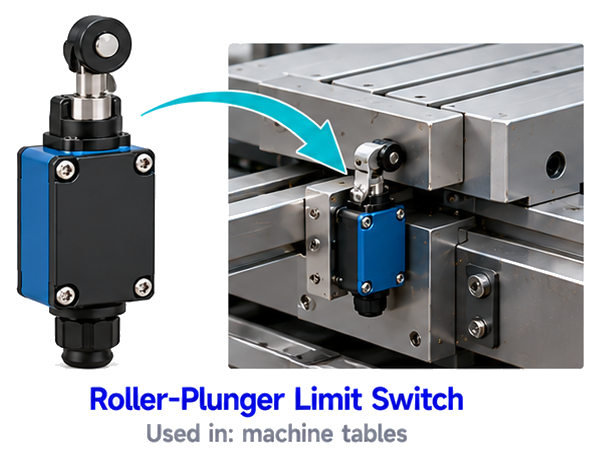
SENSOR 4 OF 10
Roller-Plunger Limit Switch
A roller-plunger limit switch has a plunger with a roller on top. A cam or slide can push the roller from the side and move the plunger smoothly. It is a good choice where a part slides across the switch, such as machine tables.
USED IN
machine tables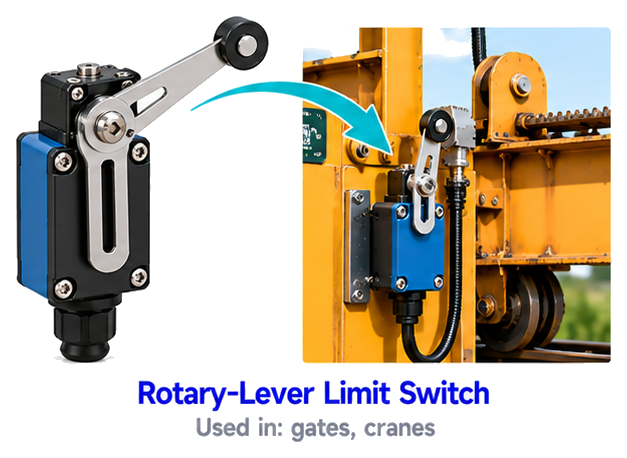
SENSOR 5 OF 10
Rotary-Lever Limit Switch
A rotary-lever limit switch has a lever on a rotating shaft. When an object turns the lever through a small angle, the contacts change. It can handle large movement and some overtravel, so it is used for gates, cranes and heavier machinery.
USED IN
gatescranes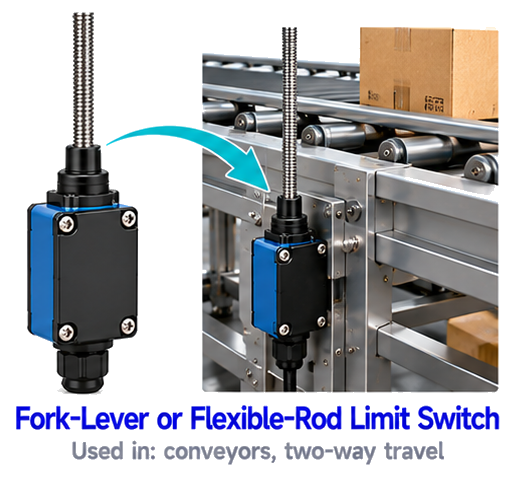
SENSOR 6 OF 10
Fork-Lever or Flexible-Rod Limit Switch
A fork-lever or flexible-rod limit switch has a lever or rod that can be pushed from either side. It operates when moved in either direction, and a flexible rod can bend without damage. It is used on conveyors and where parts approach from two directions.
USED IN
conveyorstwo-way travel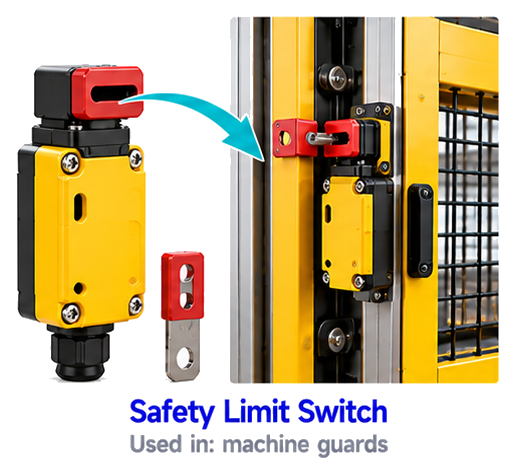
SENSOR 7 OF 10
Safety Limit Switch
A safety limit switch has positively driven contacts that open even if the contacts are welded. It is used to monitor guards and doors on machines. When the guard is opened, the switch cuts the control circuit and stops the machine, so it protects people.
USED IN
machine guards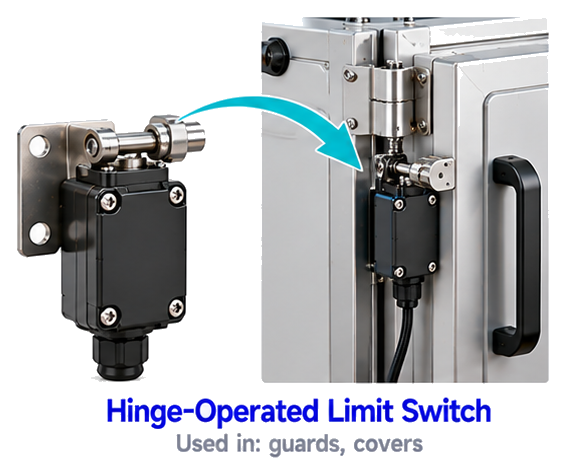
SENSOR 8 OF 10
Hinge-Operated Limit Switch
A hinge-operated limit switch is fitted on the hinge of a door or cover. When the door opens or closes, the hinge turns the switch shaft and changes the contacts. It is neat and hard to bypass, so it is used on machine guards and covers.
USED IN
guardscovers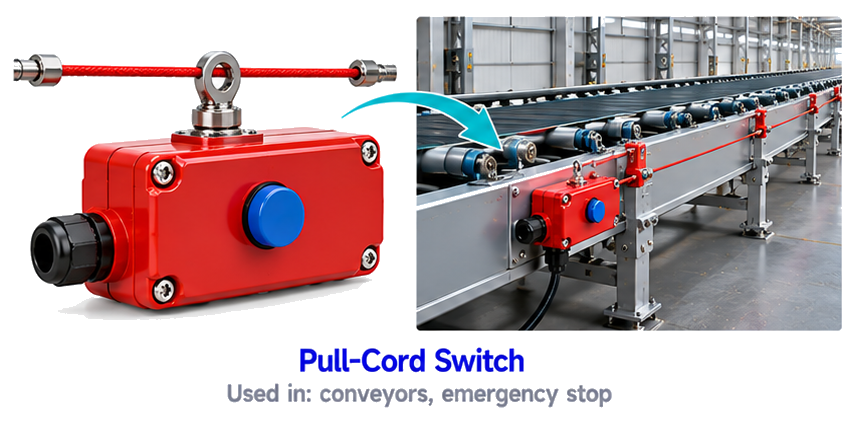
SENSOR 9 OF 10
Pull-Cord Switch
A pull-cord switch has a rope along a conveyor or machine. If someone pulls the rope anywhere along its length, the switch trips and stops the machine. It is a simple emergency stop device and is used along long conveyors.
USED IN
conveyorsemergency stop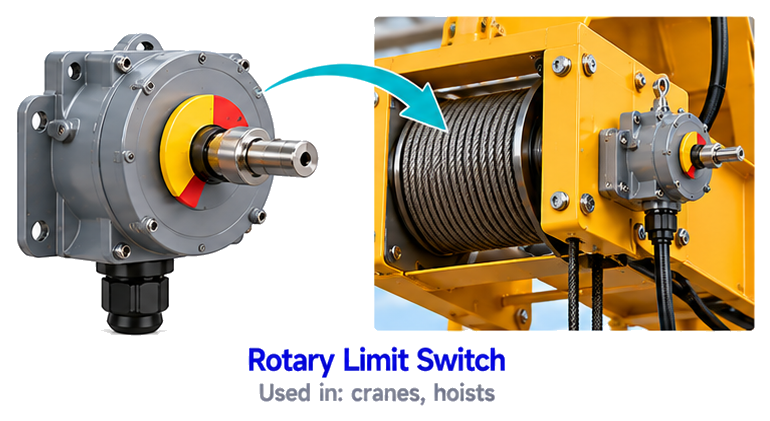
SENSOR 10 OF 10
Rotary Limit Switch
A rotary limit switch is driven by a shaft through gears. As the shaft turns, a set of cams operates several switches at different positions. It is used on cranes and hoists to set the end limits and positions of travel.
USED IN
craneshoistsWant all 250+ sensors in one place?
The Master Sensor Handbook explains every sensor with its picture, definition and where it is used.
Buy the Master Sensor Handbook | INR 199Tap the button to message us on WhatsApp
Written by Subodh Raj,
EngineerX Academy. Part 15 of 25 in the Industrial Sensors series.
Comments
Post a Comment