TORQUE SENSORS
Torque is the twisting effort, the thing you apply when you tighten a nut. If you can picture opening a stuck jar lid, you can understand torque sensors.
PART 11 OF 25 | 4 MIN READ | BY SUBODH RAJ
Force times distance. Push 10 newtons at the end of a 0.5 metre spanner and you apply 5 newton-metres (Nm). A longer spanner gives more torque for the same push, which is why a long bar loosens a stuck bolt.
How do you measure it?
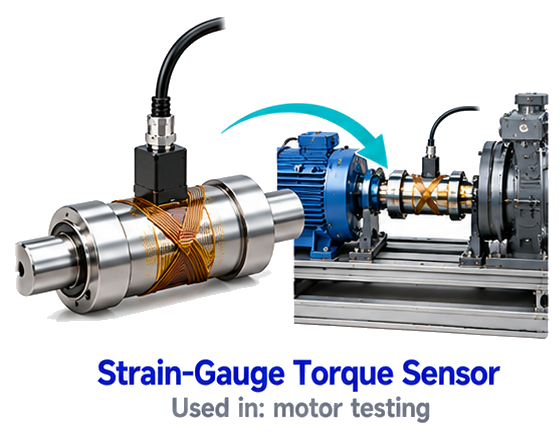
When a shaft twists under torque, its surface stretches a very small amount. Strain gauges glued to the shaft stretch with it and change resistance. The sensor reads that change. Most torque sensors use this idea. The others find different ways to see the same tiny twist.
Rotating or not rotating
- Reaction torque sensor: it sits still. A motor casing pushes against it, like holding a drill so it does not spin. Simple and tough.
- Rotary torque sensor: it sits in the shaft and spins with it. The signal must leave a spinning part, using slip rings or wireless.
Other ways to see the twist
A magnetoelastic sensor notices that a twisted steel shaft changes its magnetic behaviour. An optical sensor watches two marks move apart. Both avoid contact with the spinning shaft.
Why not just measure motor current?
Torque is roughly proportional to motor current, so drives estimate torque without any sensor. It is cheap and fine for control. It is less accurate at low speed and with friction, so test benches still use real torque sensors.
Where you meet torque sensors
Bolts on assembly lines are tightened to a set torque, and a tightening-tool transducer confirms it. Engine and motor test benches measure torque and speed together to calculate power: power in watts equals torque in Nm times angular speed in rad/s.
Remember: Easy mix-up: torque is a twisting effort, not energy and not power, even though the unit looks like energy (Nm).
The 9 sensors in this part
Each card below shows the sensor in use, what it is and how it works, and where you will find it.
SENSOR 1 OF 9
Strain-Gauge Torque Sensor
A strain-gauge torque sensor has strain gauges bonded on a shaft in a special pattern. When the shaft is twisted by torque, the gauges are stretched or compressed, and a bridge circuit converts this into a signal. The signal is proportional to the twisting force. It is used for motor and machine testing.
USED IN
motor testing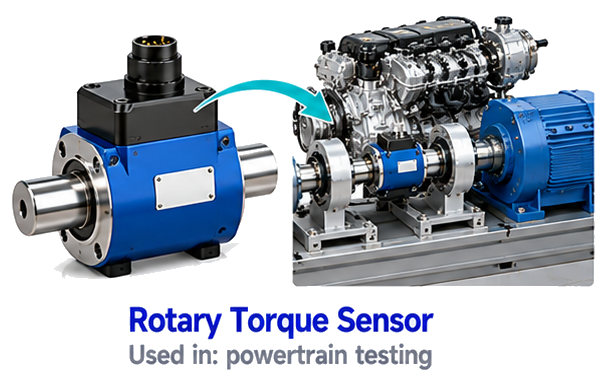
SENSOR 2 OF 9
Rotary Torque Sensor
A rotary torque sensor measures the torque on a shaft that is turning. The signal from the rotating shaft is passed out using slip rings or a wireless link. It can also measure speed. It is used for testing engines, motors, gearboxes and other power transmission parts.
USED IN
powertrain testing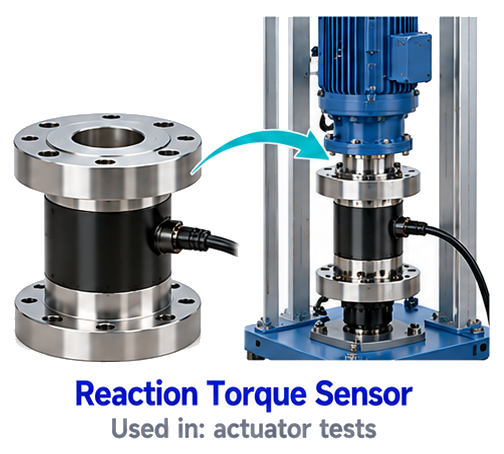
SENSOR 3 OF 9
Reaction Torque Sensor
A reaction torque sensor is fixed, not rotating. It measures the torque that is reacting against a fixed support, such as the housing of a motor or a tool. Since it does not rotate, it needs no slip rings and is simple and strong. It is used for actuator, valve and screwdriver tests.
USED IN
actuator tests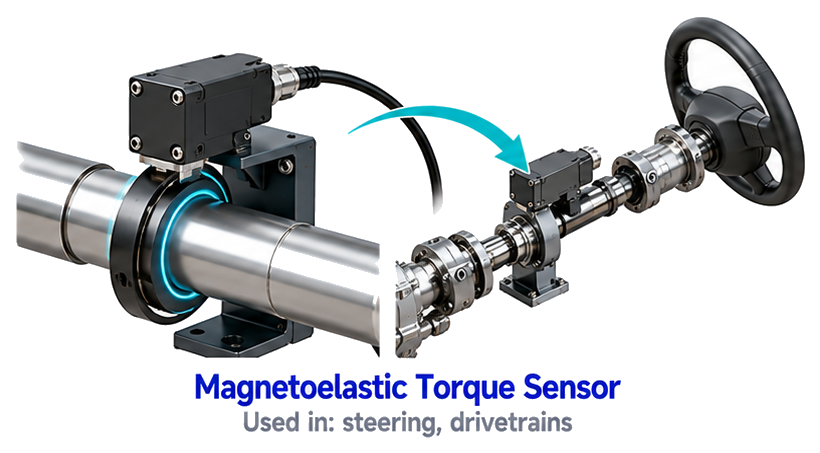
SENSOR 4 OF 9
Magnetoelastic Torque Sensor
A magnetoelastic torque sensor measures torque from the change in a shaft's magnetic properties when it is twisted. A sensor close to the shaft picks up the change in the magnetic field, without touching it. It is contactless and strong, so it is used in vehicle steering and drivetrains.
USED IN
steeringdrivetrains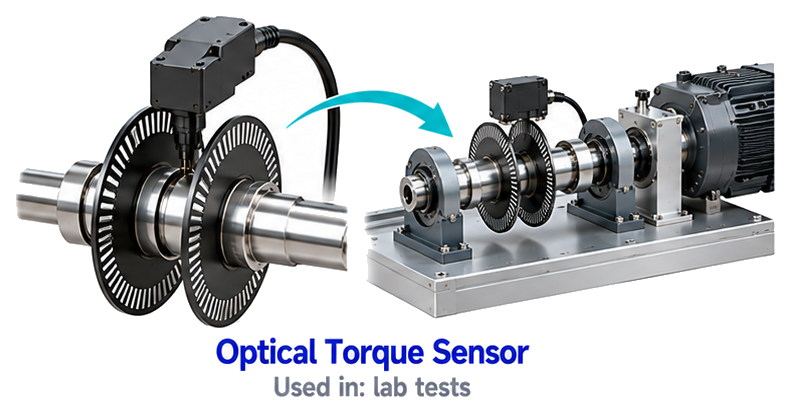
SENSOR 5 OF 9
Optical Torque Sensor
An optical torque sensor measures the small twist of a shaft using light. Two discs or marks at the two ends of a shaft section move relative to each other when torque is applied. Optical sensors read the shift. It is contactless and not affected by electrical noise, and is used in lab tests.
USED IN
lab tests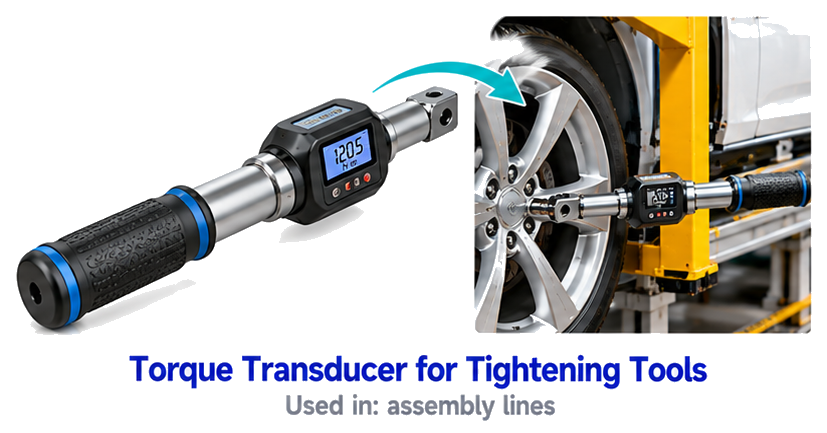
SENSOR 6 OF 9
Torque Transducer for Tightening Tools
A torque transducer for tightening tools is built into a tool such as a torque wrench, screwdriver or nut runner. It measures the torque as the bolt is tightened and gives a signal so the tool can stop at the correct value. It is used on assembly lines to ensure every bolt is tightened properly.
USED IN
assembly lines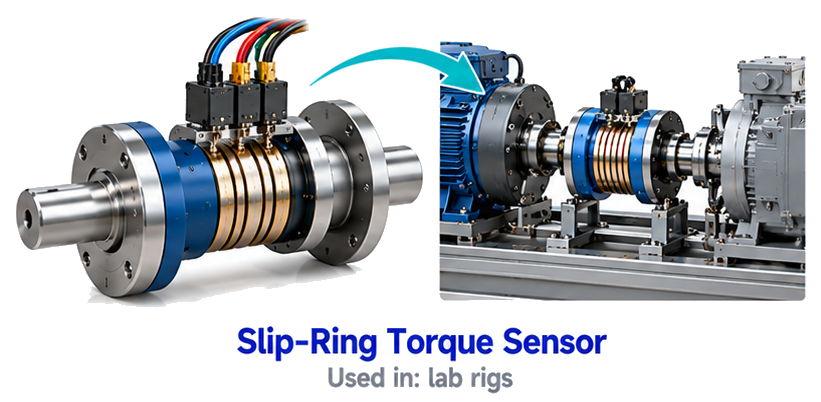
SENSOR 7 OF 9
Slip-Ring Torque Sensor
A slip-ring torque sensor sends the signal from a rotating shaft through slip rings, which are rotating conductive rings touching fixed brushes. This allows the strain-gauge signal and power to pass between the rotating and fixed parts. It is simple and used in lab rigs, but brushes wear with time.
USED IN
lab rigs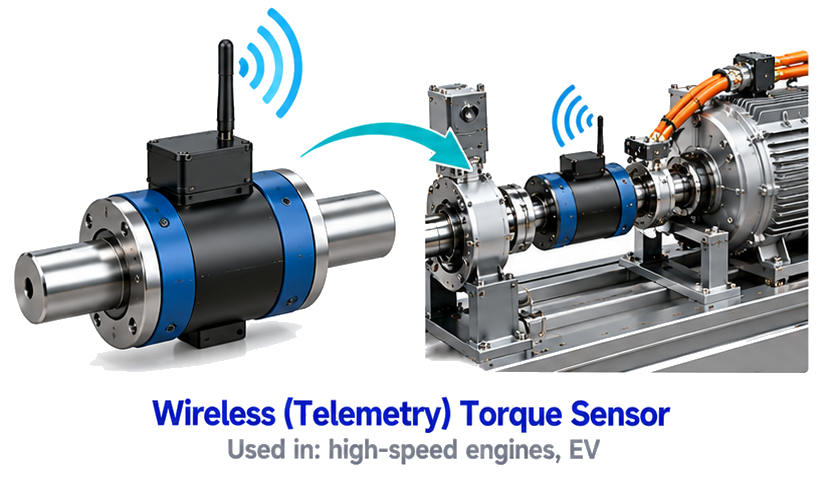
SENSOR 8 OF 9
Wireless (Telemetry) Torque Sensor
A wireless (telemetry) torque sensor sends the data from the rotating shaft by radio or inductive link. There are no brushes or contacts, so it is suited to high speeds and long tests. It is used for testing high-speed engines and electric vehicle motors.
USED IN
high-speed enginesEV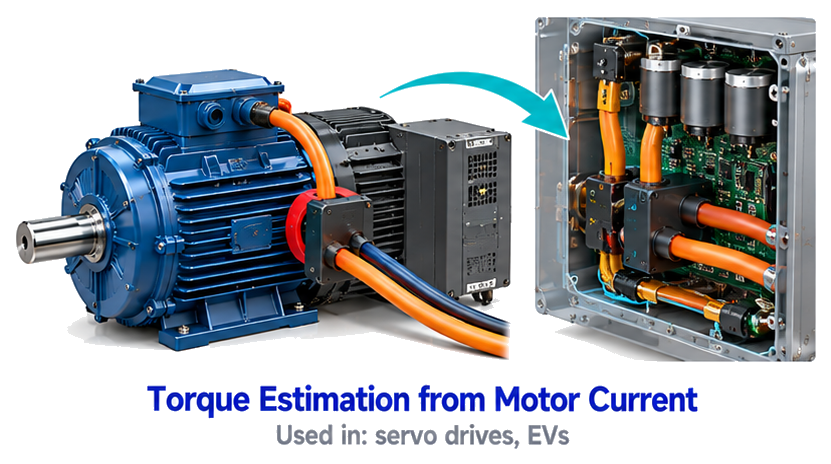
SENSOR 9 OF 9
Torque Estimation from Motor Current
Torque estimation from motor current uses the fact that the torque of a motor is nearly proportional to the current it draws. The drive measures the current and calculates the torque. No separate torque sensor is needed, so it is low cost and is used in servo drives and EVs, though it is less accurate.
USED IN
servo drivesEVsWant all 250+ sensors in one place?
The Master Sensor Handbook explains every sensor with its picture, definition and where it is used.
Buy the Master Sensor Handbook | INR 199Tap the button to message us on WhatsApp
Written by Subodh Raj,
EngineerX Academy. Part 11 of 25 in the Industrial Sensors series.
Comments
Post a Comment