VISION & OPTICAL INSPECTION SENSORS
A camera on a production line is a measuring tool. The question is never 'which is the best camera' but 'which camera fits this job'. Here are five jobs.
PART 16 OF 25 | 4 MIN READ | BY SUBODH RAJ
Job 1: Is the part present and in the right place?
A basic monochrome machine-vision camera with controlled lighting is enough. Contrast sensors and colour sensors are cheaper and faster for simple present-or-absent checks.
Job 2: Is the dimension right?
Use a telecentric lens and a high-resolution sensor, or an optical micrometer for shafts and wires. Resolution decides what you can measure: a defect must cover several pixels to be seen reliably.
Job 3: Is the surface height or shape right?
A 2D camera cannot see height. Laser triangulation projects a line, and the camera sees the line bend over the surface, which gives a profile. Use it for bead height, gaps and flatness.
Job 4: Can a robot pick this from a bin?
Random parts need depth. A 3D vision sensor, using stereo or structured light, gives the robot the position and orientation of each part.
Job 5: Is this the right product?
Read barcodes, QR and Data Matrix codes, or run OCR on printed dates. Check the contrast of the print and the quality grade of the code, not just whether it reads once.
CCD or CMOS?
CCD sensors gave very clean, low-noise images for years. Modern CMOS sensors are faster, cheaper and use less power, and their quality now matches or beats CCD for most factory work.
Remember: Lighting solves more vision problems than a better camera. Fix the light, the angle and the background first.
The 10 sensors in this part
Each card below shows the sensor in use, what it is and how it works, and where you will find it.
SENSOR 1 OF 10
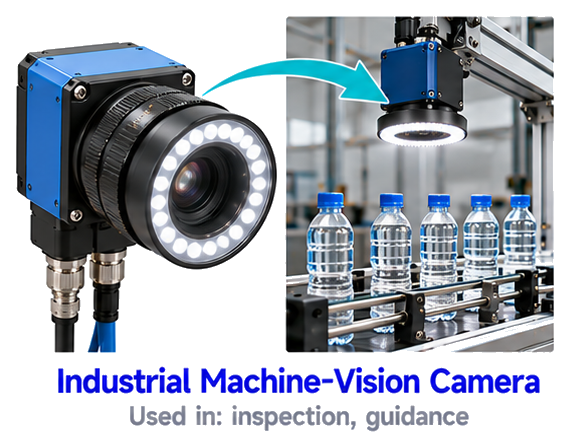
Industrial Machine-Vision Camera
An industrial machine-vision camera takes pictures of products in a factory. Software looks at the images and checks things such as size, shape, colour, presence and codes. It can inspect quickly and without tiring, and is used for quality inspection and for guiding robots.
USED IN
inspectionguidance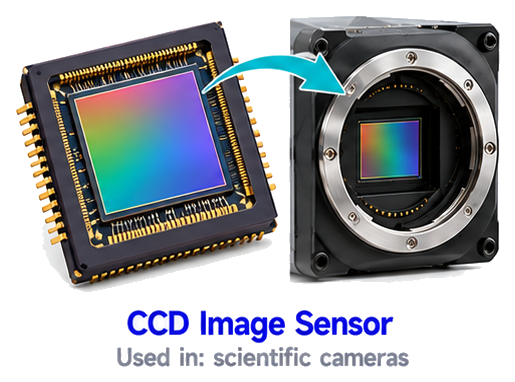
SENSOR 2 OF 10
CCD Image Sensor
A CCD (Charge-Coupled Device) image sensor is a chip with many small light-sensitive pixels. Each pixel collects charge from light, and the charges are moved out one by one and read. CCDs give very clean, low-noise images, so they are used in scientific and special cameras.
USED IN
scientific cameras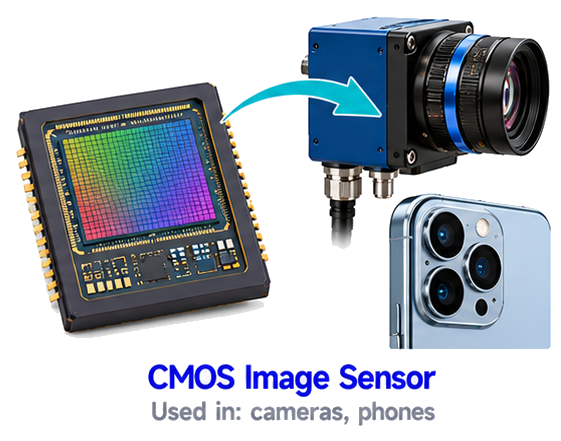
SENSOR 3 OF 10
CMOS Image Sensor
A CMOS image sensor is a chip with many pixels, each with its own small amplifier. It is faster, uses less power and is cheaper than CCD. The image quality is now very good, so it is used in most cameras, phones and machine-vision systems.
USED IN
camerasphones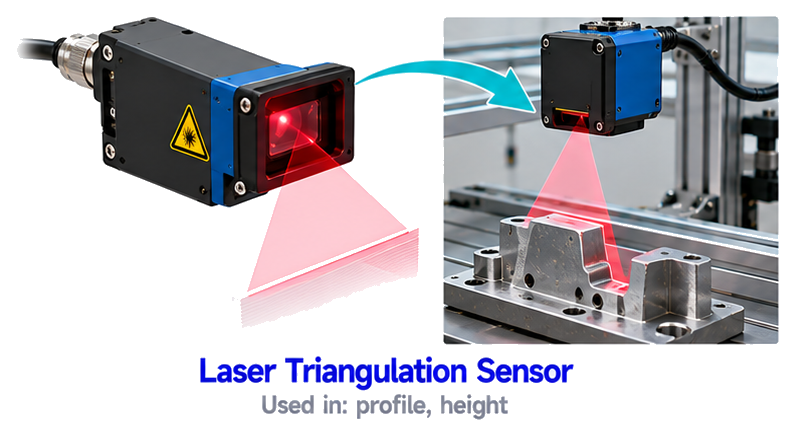
SENSOR 4 OF 10
Laser Triangulation Sensor
A laser triangulation sensor projects a laser spot or line onto an object. A camera sees it from an angle, and where the spot appears on the detector depends on the object's height. This gives accurate distance or a surface profile. It is used for height and shape checks.
USED IN
profileheight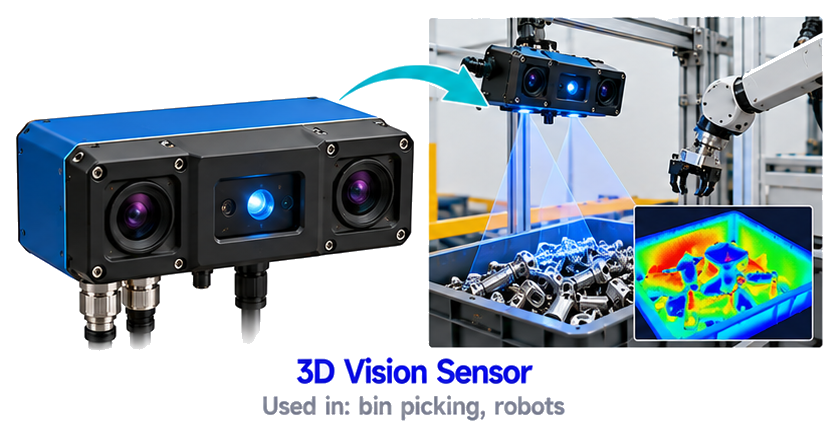
SENSOR 5 OF 10
3D Vision Sensor
A 3D vision sensor captures the depth of a scene as well as its image, using stereo cameras, structured light or time-of-flight. This gives a 3D map of objects. It lets robots find and pick objects placed randomly, as in bin picking.
USED IN
bin pickingrobots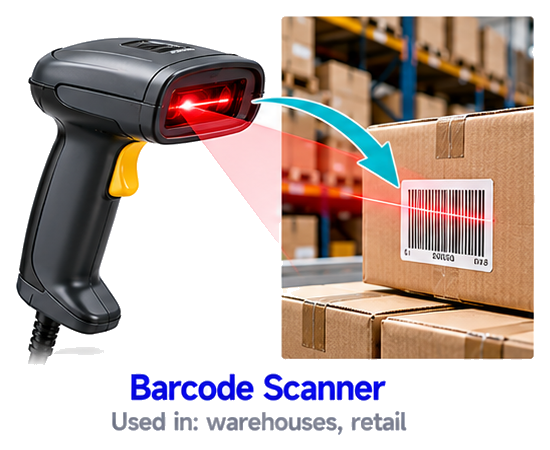
SENSOR 6 OF 10
Barcode Scanner
A barcode scanner reads the pattern of black and white lines of a barcode. A laser or camera scans the code, and the software converts the pattern into numbers and text. It is fast and accurate and is used for stock, billing and tracking in warehouses and retail.
USED IN
warehousesretail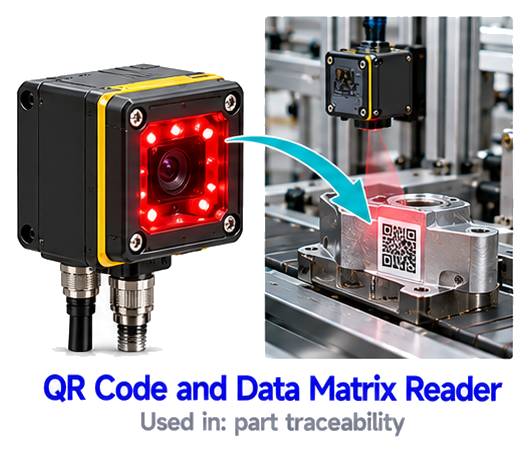
SENSOR 7 OF 10
QR Code and Data Matrix Reader
A QR code and Data Matrix reader reads two-dimensional codes that store much more data than a barcode in a small area. A camera takes an image of the code and software decodes it. Data Matrix is often marked on parts for traceability, and QR is common on labels and products.
USED IN
part traceability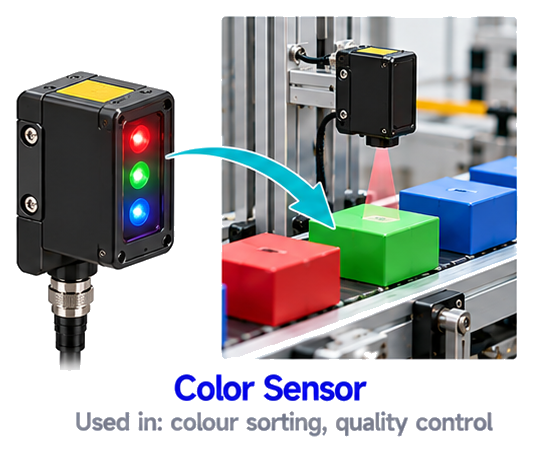
SENSOR 8 OF 10
Color Sensor
A color sensor detects the colour of an object. It shines light on the object and measures the reflected red, green and blue parts, then compares them with a stored colour. It is used for sorting by colour and for checking quality and the correct product.
USED IN
colour sortingquality control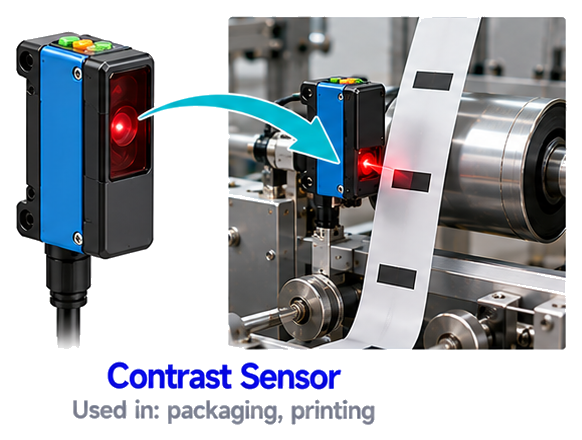
SENSOR 9 OF 10
Contrast Sensor
A contrast sensor detects the difference in brightness between a mark and its background. It does not need a specific colour, only enough difference between light and dark. It is used on packaging and printing machines to find registration marks and print marks.
USED IN
packagingprinting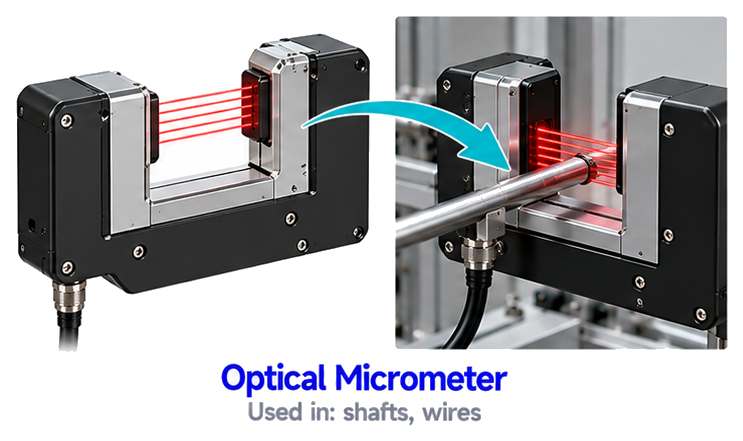
SENSOR 10 OF 10
Optical Micrometer
An optical micrometer sends a wide beam of light across a gap and measures the shadow of an object in the beam. The width of the shadow gives the size, for example the diameter of a shaft or a wire. It is fast, non-contact and very accurate.
USED IN
shaftswiresWant all 250+ sensors in one place?
The Master Sensor Handbook explains every sensor with its picture, definition and where it is used.
Buy the Master Sensor Handbook | INR 199Tap the button to message us on WhatsApp
Written by Subodh Raj,
EngineerX Academy. Part 16 of 25 in the Industrial Sensors series.
Comments
Post a Comment