VIBRATION & ACCELERATION SENSORS
A healthy machine hums in a steady way. When something starts to go wrong, the pattern of vibration changes long before anything breaks. Reading that pattern is the heart of condition monitoring.
PART 12 OF 25 | 4 MIN READ | BY SUBODH RAJ
Symptom table
| What you see | Likely cause | Typical sign |
|---|
| High vibration at 1x running speed | Unbalance | Mostly in the radial direction |
| High at 1x and 2x, large in axial direction | Misalignment | Between coupled machines |
| Many harmonics and a noisy base | Looseness | Worse after warm-up or at one mount |
| High-frequency spikes | Early bearing faults | Appear before temperature rises |
| Vibration at gear mesh frequency | Gear wear or damage | Sidebands around the mesh frequency |
Which sensor is looking
- Piezoelectric and IEPE accelerometers: the standard tool. They see a wide frequency range, good for bearings and gears.
- MEMS accelerometers: low cost, useful for wireless monitoring and low frequencies.
- Velocity sensors: report how fast the part moves, closely linked to vibration severity in ISO charts.
- Eddy-current proximity probes: measure the shaft itself relative to the bearing, used on big turbines and compressors.
- Vibration switches: a simple trip when vibration crosses a limit, used on cooling-tower fans.
Mounting matters more than people think
A loose or painted mounting surface lowers the frequency a sensor can measure. Use a clean, flat spot, and a stud mount where possible. A magnet is quick but works only up to moderate frequencies.
Trend, do not just measure once
One reading tells you little. Log readings every week. A slow climb is a warning, and a sudden jump is an alarm. Most failures give weeks of notice if someone is watching the trend.
Remember: Take readings at the same load and speed each time. Otherwise differences come from the operating condition, not the machine health.
The 10 sensors in this part
Each card below shows the sensor in use, what it is and how it works, and where you will find it.
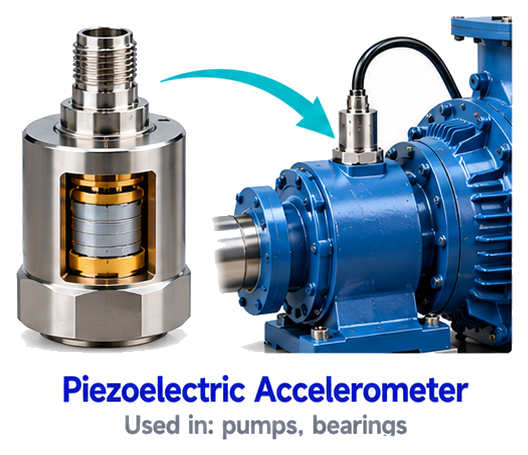
SENSOR 1 OF 10
Piezoelectric Accelerometer
A piezoelectric accelerometer has a small mass resting on a piezoelectric crystal. When the sensor vibrates, the mass presses on the crystal with a force proportional to acceleration, and the crystal gives a charge. It has a wide frequency range and is the standard sensor for monitoring pumps and bearings.
USED IN
pumpsbearings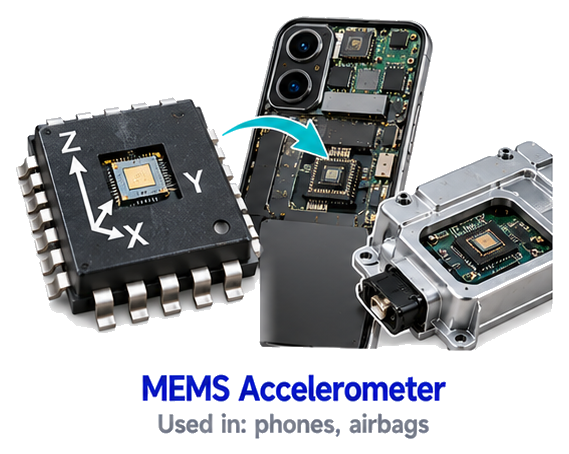
SENSOR 2 OF 10
MEMS Accelerometer
A MEMS accelerometer is a tiny silicon chip with a micro-sized moving mass. When it accelerates, the mass moves and changes the capacitance, which is converted into a signal. It measures both vibration and steady tilt, and is small, low cost and low power, so it is used in phones, airbags and gadgets.
USED IN
phonesairbags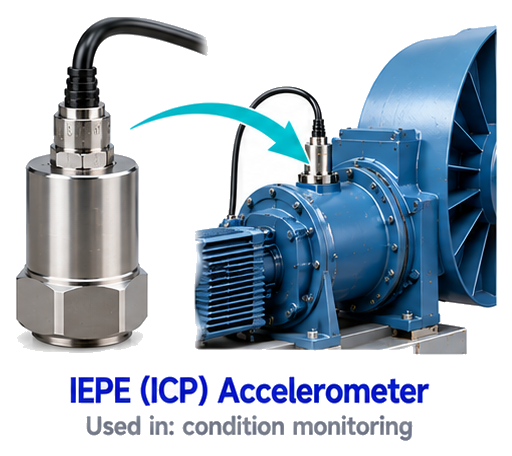
SENSOR 3 OF 10
IEPE (ICP) Accelerometer
An IEPE (ICP) accelerometer is a piezoelectric accelerometer with a small amplifier built inside. It uses a simple two-wire cable that carries both power and signal. Because the signal is amplified near the sensor, it is less affected by noise. It is very common in machine condition monitoring.
USED IN
condition monitoring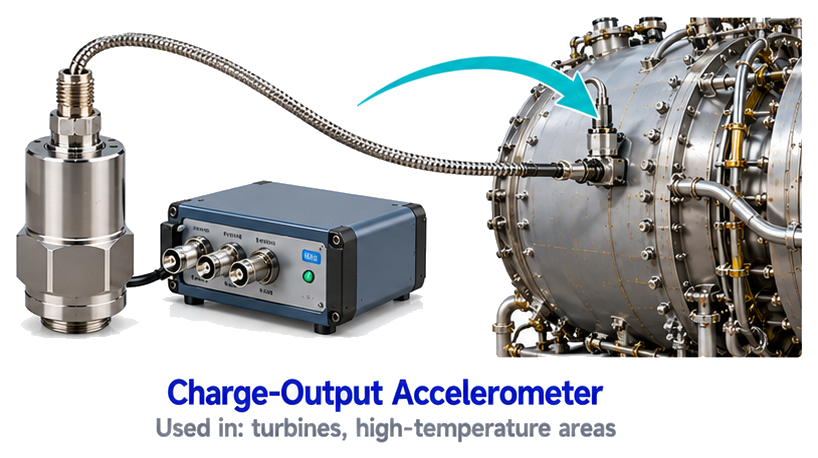
SENSOR 4 OF 10
Charge-Output Accelerometer
A charge-output accelerometer is a piezoelectric accelerometer without built-in electronics, and it gives a raw charge signal. As it has no electronics inside, it can work at very high temperatures, where amplifiers would fail. It needs a charge amplifier and is used on turbines and hot machinery.
USED IN
turbineshigh-temperature areas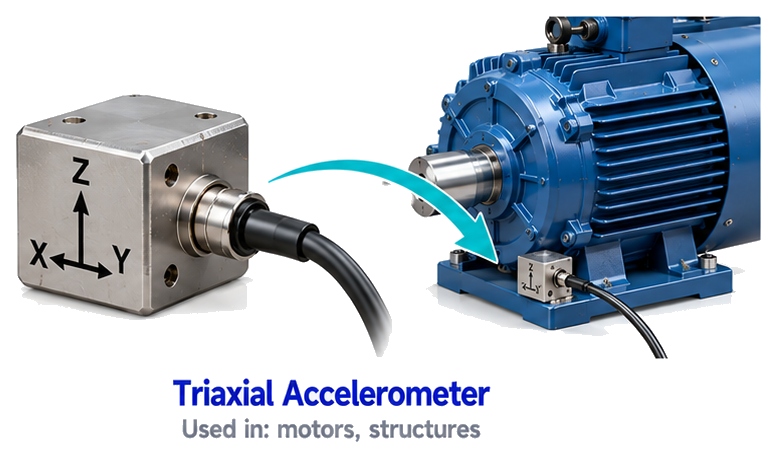
SENSOR 5 OF 10
Triaxial Accelerometer
A triaxial accelerometer measures acceleration or vibration in three directions at the same time: X, Y and Z. It has three sensing elements fixed at right angles in a single body. This saves time and gives a full picture of the vibration of motors, machines and structures.
USED IN
motorsstructures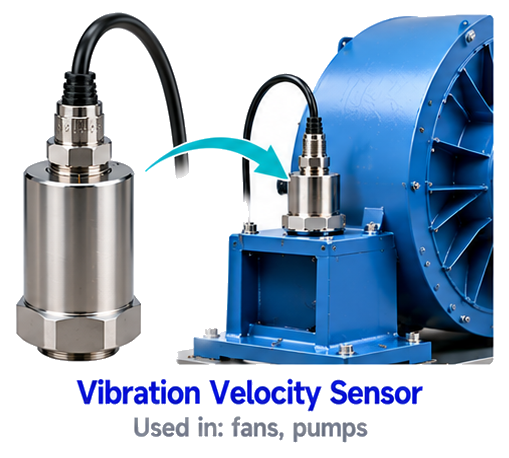
SENSOR 6 OF 10
Vibration Velocity Sensor
A vibration velocity sensor measures how fast a machine part is moving back and forth. The velocity is closely related to the energy and damage of vibration. It is widely used in standards such as ISO for judging machine health in fans, pumps and motors.
USED IN
fanspumps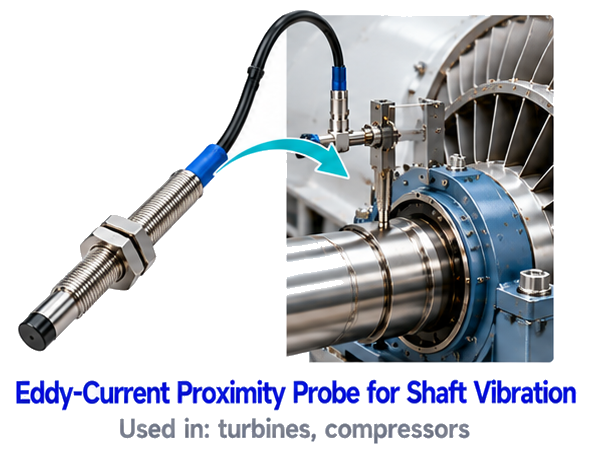
SENSOR 7 OF 10
Eddy-Current Proximity Probe for Shaft Vibration
An eddy-current proximity probe for shaft vibration is fixed close to a rotating shaft without touching it. It measures the changing gap between the probe and the shaft, which shows how the shaft vibrates inside its bearings. It is used on turbines and compressors, and also shows the shaft position.
USED IN
turbinescompressors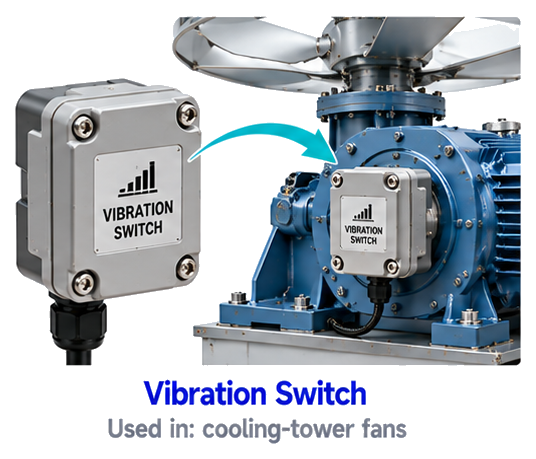
SENSOR 8 OF 10
Vibration Switch
A vibration switch gives a contact signal when the vibration goes above a set limit. It can use a mechanical mass or an electronic sensor. When the vibration is too high, it trips an alarm or stops the machine. It is used for protection, for example on cooling-tower fans.
USED IN
cooling-tower fans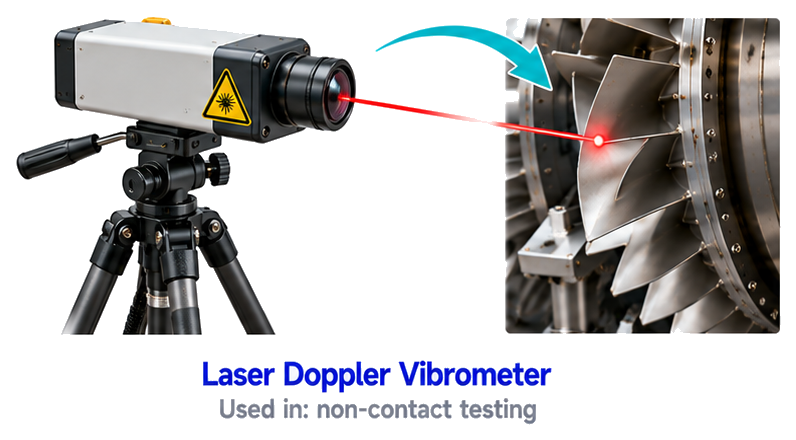
SENSOR 9 OF 10
Laser Doppler Vibrometer
A laser Doppler vibrometer sends a laser beam at a vibrating surface and measures the shift in frequency of the reflected light (the Doppler effect). This shift gives the velocity of the surface. It measures vibration without touching or loading the object, so it suits light, hot or small parts.
USED IN
non-contact testing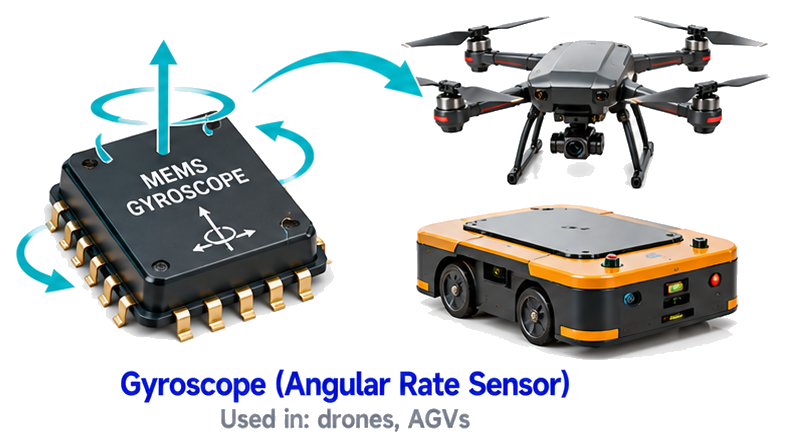
SENSOR 10 OF 10
Gyroscope (Angular Rate Sensor)
A gyroscope (angular rate sensor) measures how fast an object is rotating or turning. Most modern gyros are MEMS chips with a tiny vibrating structure whose motion changes when it is rotated. It is used in drones, AGVs, phones and vehicles to know the rotation and keep direction.
USED IN
dronesAGVsWant all 250+ sensors in one place?
The Master Sensor Handbook explains every sensor with its picture, definition and where it is used.
Buy the Master Sensor Handbook | INR 199Tap the button to message us on WhatsApp
Written by Subodh Raj,
EngineerX Academy. Part 12 of 25 in the Industrial Sensors series.
Comments
Post a Comment