DISTANCE & DISPLACEMENT SENSORS
Everyone says they want to measure distance, but a 3 mm gap on a turbine shaft and a 20 m crane position are different problems. Start with the job, then pick the sensor.
PART 5 OF 25 | 4 MIN READ | BY SUBODH RAJ
If you need micrometre accuracy on a small gap
Choose eddy-current or capacitive displacement sensors. Eddy-current probes work on metal targets and survive oil and dirt, which is why they guard turbine and compressor shafts. Capacitive probes give even finer resolution, down to nanometres, but the surface must be clean and dry.
If you need to follow a moving rod inside a cylinder
Use a magnetostrictive sensor or an LVDT. The magnetostrictive type reads the position of a ring magnet along a rod and has no wear. An LVDT has a core that never touches its coils, so it has very long life, and it is a classic choice for valves and test rigs.
If you need a few metres with simple wiring
A draw-wire sensor is the easy option for lifts, presses and cranes. A steel wire unwinds from a spring drum and the sensor counts the rotation. A linear potentiometer is cheaper but wears, so keep it for light-duty or temporary setups.
If you cannot touch the target
- Laser displacement: very accurate, good for thickness, gap and height, but sensitive to shiny or transparent surfaces.
- Ultrasonic: works on almost any surface, even liquids and clear plastic, but the beam is wide and temperature changes the speed of sound.
- Time-of-flight: small, cheap, fast, ideal for robots and presence detection at a medium range.
- LiDAR: scans many points to build a map, used on mobile robots and vehicles.
A simple selection table
| Job | First choice |
|---|
| Shaft vibration and gap | Eddy-current probe |
| Hydraulic cylinder position | Magnetostrictive |
| Crane or lift height | Draw-wire |
| Tank or pallet distance | Ultrasonic |
| Part thickness on a line | Laser |
| Robot navigation | LiDAR or ToF |
Remember: Check three numbers on every datasheet: range, resolution and linearity. A sensor can have fine resolution and still read wrong if its linearity is poor.
The 10 sensors in this part
Each card below shows the sensor in use, what it is and how it works, and where you will find it.
SENSOR 1 OF 10
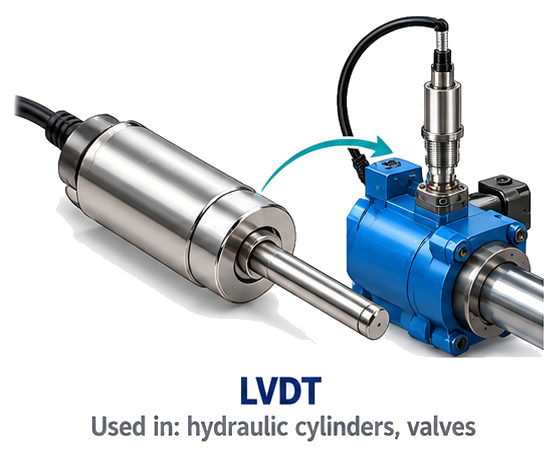
LVDT
An LVDT (Linear Variable Differential Transformer) measures small straight-line movement. It has one primary coil and two secondary coils, with a movable iron core inside. As the core moves, the voltage in the secondary coils changes in proportion to its position. It has no contact friction, so it is very accurate and long-lasting.
USED IN
hydraulic cylindersvalves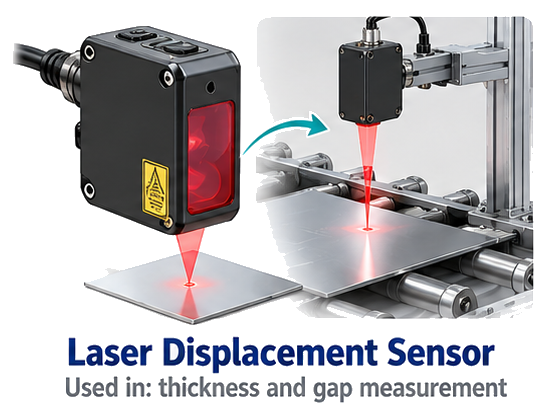
SENSOR 2 OF 10
Laser Displacement Sensor
A laser displacement sensor measures distance or movement using a laser spot. The spot lands on the object, and the reflected light falls on a detector at an angle that depends on the distance (triangulation). It is non-contact and very accurate, so it is used for thickness, gap, height and vibration measurement.
USED IN
thickness and gap measurement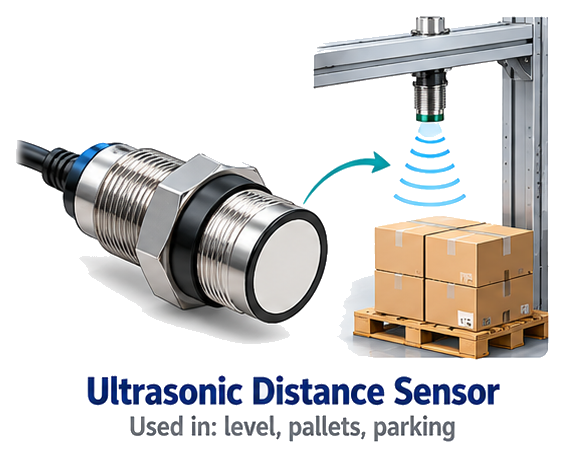
SENSOR 3 OF 10
Ultrasonic Distance Sensor
An ultrasonic distance sensor sends out a burst of high-frequency sound and listens for the echo. The time taken for the echo to return is converted into distance. It works with most materials, even transparent ones, and is not affected by colour, so it is used for level, pallet detection and parking.
USED IN
levelpalletsparking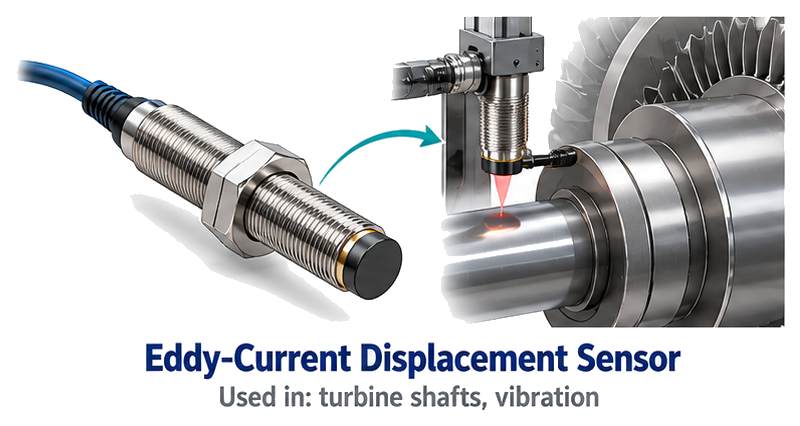
SENSOR 4 OF 10
Eddy-Current Displacement Sensor
An eddy-current displacement sensor measures the gap between its tip and a metal target without touching. A coil produces a high-frequency magnetic field that creates eddy currents in the metal. The gap changes these currents, and the electronics convert the change into distance. It is very accurate and works in oil and dirt.
USED IN
turbine shaftsvibration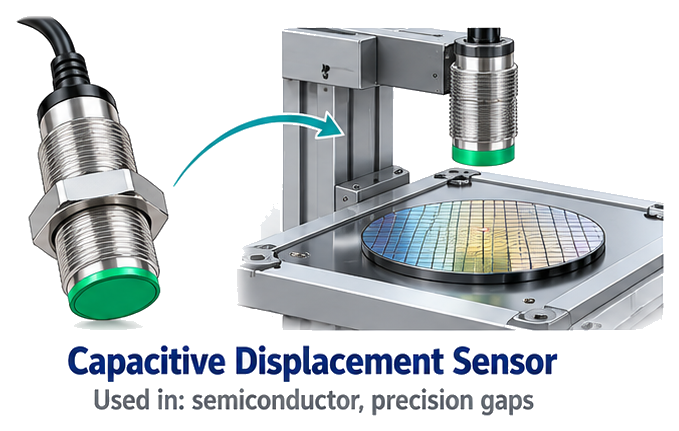
SENSOR 5 OF 10
Capacitive Displacement Sensor
A capacitive displacement sensor measures extremely small gaps between its probe and a target. The probe and the target act as two plates of a capacitor, and the capacitance changes with the gap. It gives very high resolution, even down to nanometres, so it is used in semiconductor and precision machines.
USED IN
semiconductorprecision gaps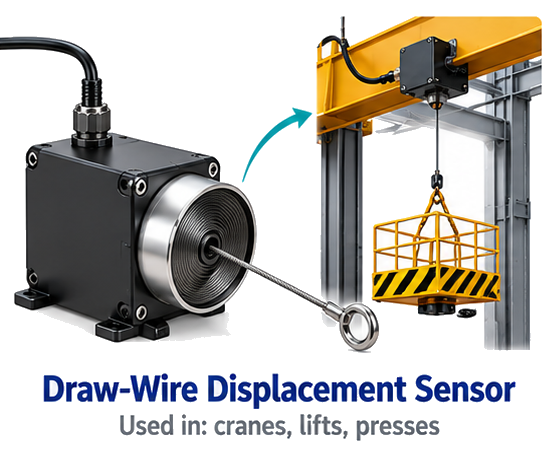
SENSOR 6 OF 10
Draw-Wire Displacement Sensor
A draw-wire displacement sensor has a thin steel wire wound on a spring-loaded drum. One end of the wire is attached to the moving part. As the part moves, the wire is pulled out and the drum rotates, and a sensor inside converts this to length. It is simple, compact and good for long strokes.
USED IN
cranesliftspresses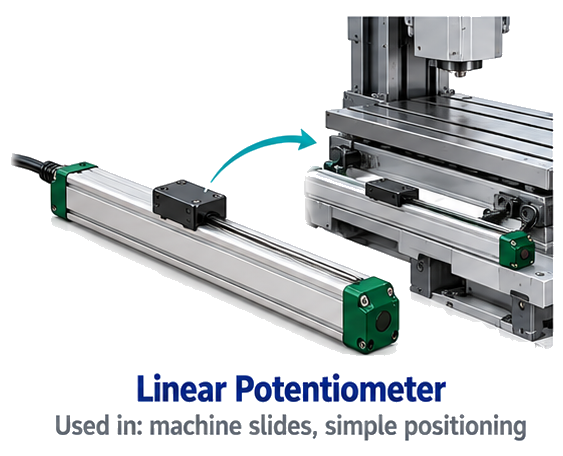
SENSOR 7 OF 10
Linear Potentiometer
A linear potentiometer has a resistive track and a sliding contact (wiper) that moves along it. The output voltage depends on where the wiper is, so it tells the position. It is simple, low cost and easy to use, but the sliding contact wears out over time, so its life is limited.
USED IN
machine slidessimple positioning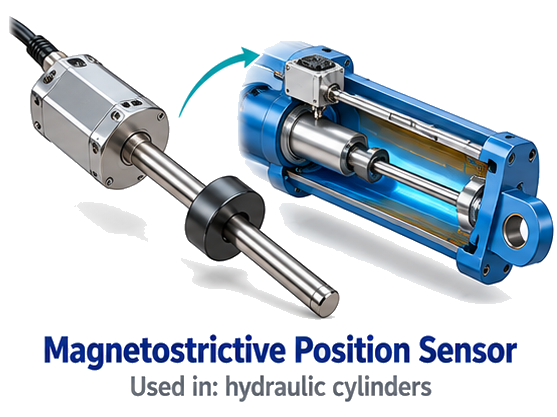
SENSOR 8 OF 10
Magnetostrictive Position Sensor
A magnetostrictive position sensor has a metal rod (waveguide) and a magnet that moves along it. A current pulse and the magnet's field create a tiny twist pulse in the rod. The time it takes to reach the end gives the exact magnet position. It is contactless, accurate and strong, so it is common in hydraulic cylinders.
USED IN
hydraulic cylinders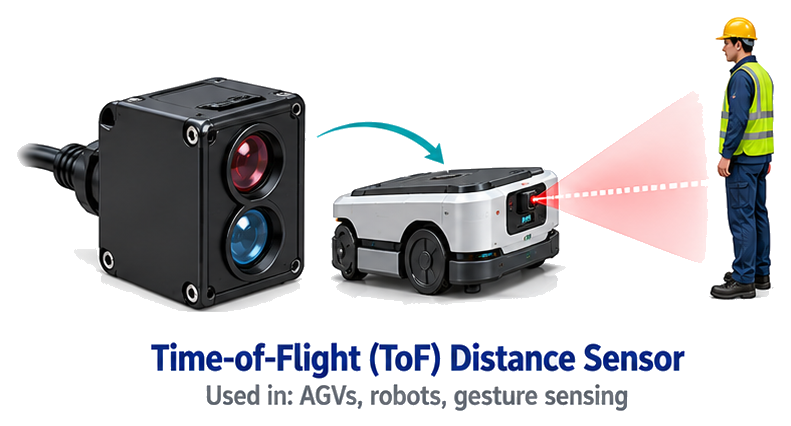
SENSOR 9 OF 10
Time-of-Flight (ToF) Distance Sensor
A Time-of-Flight (ToF) distance sensor sends a pulse of light and measures how long it takes to come back from the object. Since light speed is known, the time is converted to distance. It is compact and fast and can work over a medium range, so it is used in robots, AGVs and gesture sensing.
USED IN
AGVsrobotsgesture sensing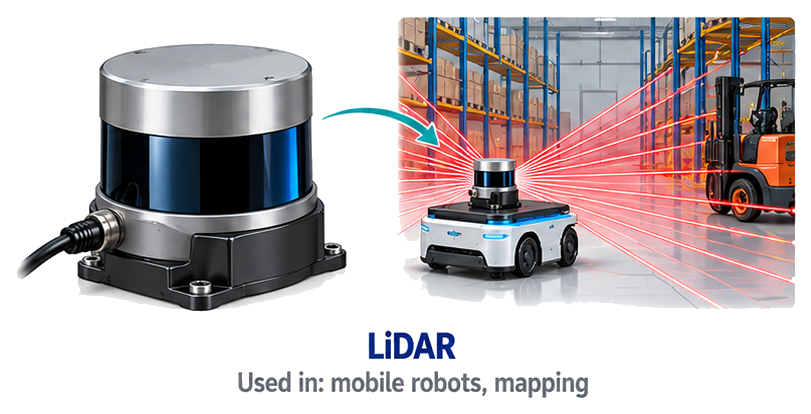
SENSOR 10 OF 10
LiDAR
LiDAR (Light Detection and Ranging) sends laser pulses in many directions, often with a spinning mirror, and measures the time for each to return. This gives the distance to many points around it, which makes a map of the surroundings. It is used in mobile robots, self-driving vehicles and surveying.
USED IN
mobile robotsmappingWant all 250+ sensors in one place?
The Master Sensor Handbook explains every sensor with its picture, definition and where it is used.
Buy the Master Sensor Handbook | INR 199Tap the button to message us on WhatsApp
Written by Subodh Raj,
EngineerX Academy. Part 5 of 25 in the Industrial Sensors series.
Comments
Post a Comment