FORCE & LOAD SENSORS
A feed plant wants to know how much grain is in a silo without climbing it. The answer is to weigh the silo. This case study shows how to size and place load cells, with numbers.
PART 10 OF 25 | 4 MIN READ | BY SUBODH RAJ
The setup
The silo weighs 4 tonnes empty and holds 20 tonnes of grain at full. It stands on four legs. Total maximum load is therefore 24 tonnes, which is 24,000 kg.
With four load cells, each carries about 24,000 / 4 = 6,000 kg at full load. But the load is never perfectly even, and wind and filling shocks add force.
Step 2: add a safety margin
A common rule is to choose cells with a total capacity of 1.5 to 2 times the maximum load. Here, 24,000 x 1.5 = 36,000 kg total. Divided by four cells, that is 9,000 kg each, so a standard 10-tonne compression cell fits.
Step 3: choose the cell type
- Compression canister cells suit silo legs, since the weight presses straight down.
- Shear-beam cells suit platform scales and tank mounts.
- Hydraulic or pneumatic cells make sense where there is no power or the area is hazardous.
- A load pin fits where the load goes through a pin joint, such as crane hooks.
Step 4: mount it properly
Use mounting kits that allow small movements from heat and wind. Add check rods or stay rods so the silo cannot tip or slide. Cables from the cells go to a junction box, where small trim adjustments level the cells, then to the weight indicator.
Step 5: calibrate
First set zero with the silo empty. Then add test weights or known quantities of grain and adjust the span. Real calibration beats trusting the cell's datasheet.
Remember: Common failure: a pipe or cable rigidly attached to the silo shares the load and makes the reading wrong. Use flexible connections for everything that leaves the silo.
What the plant gained
The same weighing system then controls batching, shows inventory, and detects bridging inside the silo when weight stops dropping though the outlet is open.
The 11 sensors in this part
Each card below shows the sensor in use, what it is and how it works, and where you will find it.
SENSOR 1 OF 11
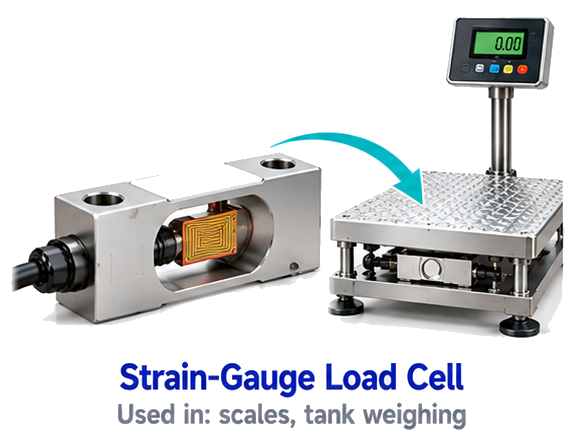
Strain-Gauge Load Cell
A strain-gauge load cell is a metal block or beam that bends slightly when weight is applied. Strain gauges bonded on it stretch or compress, changing their resistance. A bridge circuit converts this into a small voltage proportional to the weight. It is the most common type of load cell and is used in scales and tank weighing.
USED IN
scalestank weighing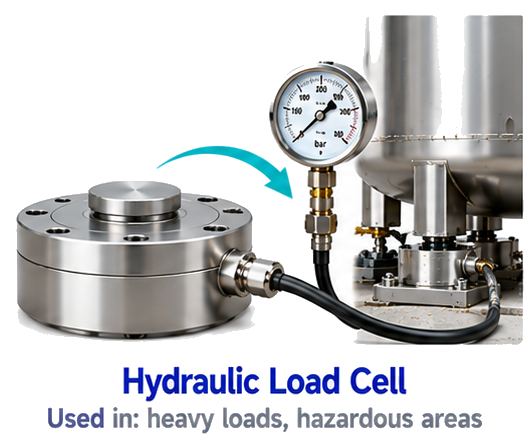
SENSOR 2 OF 11
Hydraulic Load Cell
A hydraulic load cell has a piston resting on a chamber filled with oil. The load pushes the piston and raises the oil pressure, and a gauge or pressure sensor shows the weight. It needs no electricity at the cell and is rugged, so it is suited to heavy loads and hazardous areas.
USED IN
heavy loadshazardous areas
SENSOR 3 OF 11
Pneumatic Load Cell
A pneumatic load cell uses air pressure to balance the load. The load pushes on a diaphragm, and air is supplied until the pressure balances the force. The air pressure is then a measure of weight. It is safe in explosive or wet places and is used in hygienic or hazardous areas.
USED IN
hygienic and hazardous areas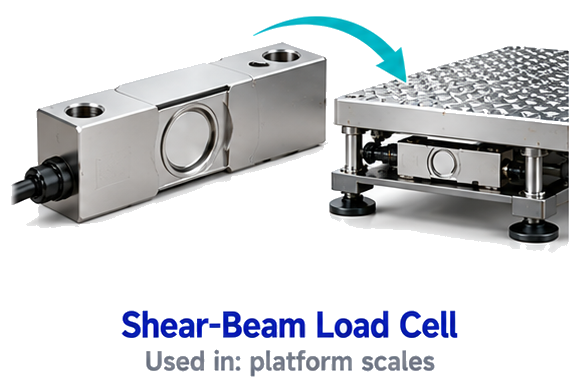
SENSOR 4 OF 11
Shear-Beam Load Cell
A shear-beam load cell has strain gauges placed to sense the shear (sliding) force inside a short beam. It gives accurate readings and is not affected much by where the load is applied. It is strong and is widely used in platform scales, tank weighing and floor scales.
USED IN
platform scales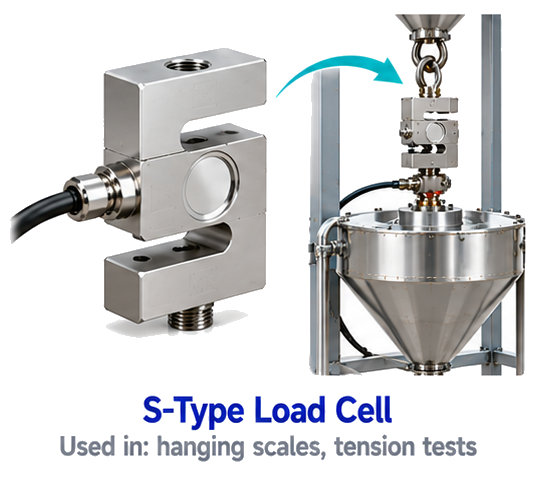
SENSOR 5 OF 11
S-Type Load Cell
An S-type load cell is shaped like the letter S. It can measure both tension (pulling) and compression (pushing) forces. It is compact and is commonly hung from a frame for weighing hanging loads, and for tension and compression testing machines.
USED IN
hanging scalestension tests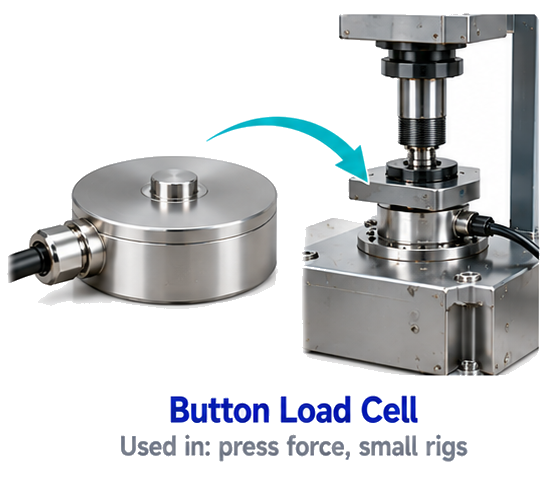
SENSOR 6 OF 11
Button Load Cell
A button load cell is a small, round, flat load cell shaped like a button. It measures compression force on its top surface and fits in a very small space. It is used where the load is applied directly, such as in press force monitoring and test rigs.
USED IN
press forcesmall rigs
SENSOR 7 OF 11
Piezoelectric Force Sensor
A piezoelectric force sensor uses a quartz or ceramic crystal that gives an electric charge when force is applied. It responds extremely fast and has very high stiffness. It is good for impact, vibration and fast-changing forces, but it is not suitable for measuring steady weight for a long time.
USED IN
impact testsdynamic force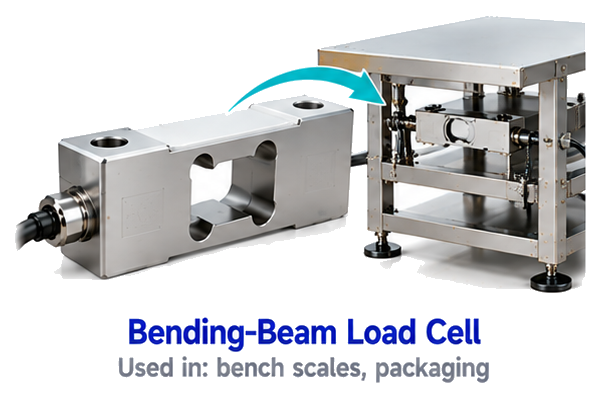
SENSOR 8 OF 11
Bending-Beam Load Cell
A bending-beam load cell is a metal beam fixed at one end, with the load applied at the other end. The beam bends, and strain gauges on its top and bottom surfaces measure the bending. It is low cost and accurate for small to medium loads, so it is used in bench scales and packaging machines.
USED IN
bench scalespackaging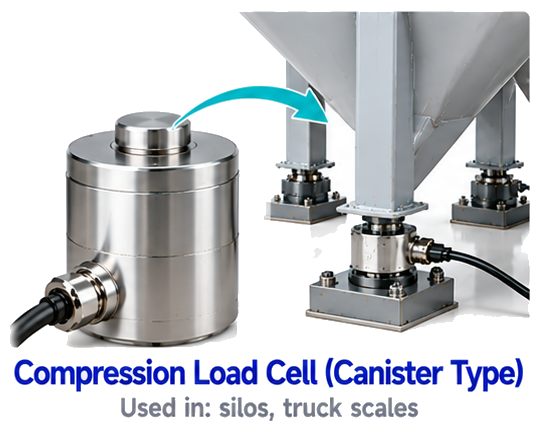
SENSOR 9 OF 11
Compression Load Cell (Canister Type)
A compression load cell (canister type) is a tall, round column that is loaded from the top. The force squeezes the column, and the strain gauges inside measure the change. It can carry very heavy loads and is used under silos, tanks and truck scales.
USED IN
silostruck scales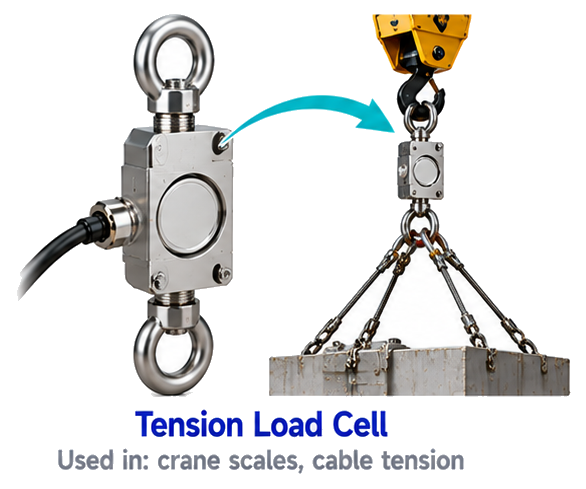
SENSOR 10 OF 11
Tension Load Cell
A tension load cell is designed to measure pulling force. It is fitted in line with a rope, cable, chain or rod, with an eye or hook at each end. As the load pulls on it, strain gauges measure the stretch. It is used in crane scales and for checking cable tension.
USED IN
crane scalescable tension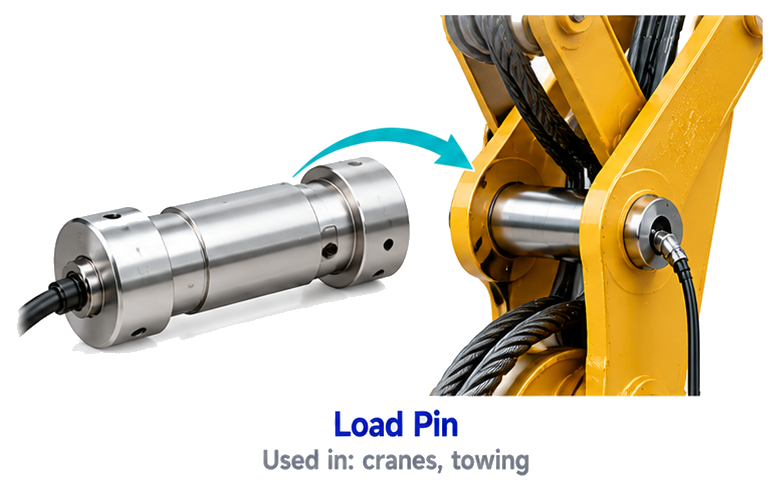
SENSOR 11 OF 11
Load Pin
A load pin is a strong steel pin that works as a load cell. It is used in place of a normal pin in a clevis, sheave or hook. The force passing through the pin causes a small shear in it, which strain gauges measure. It is used in cranes, winches and towing equipment.
USED IN
cranestowingWant all 250+ sensors in one place?
The Master Sensor Handbook explains every sensor with its picture, definition and where it is used.
Buy the Master Sensor Handbook | INR 199Tap the button to message us on WhatsApp
Written by Subodh Raj,
EngineerX Academy. Part 10 of 25 in the Industrial Sensors series.
Comments
Post a Comment