Position and Rotation Sensors: 8 Myths Technicians Still Believe
The 9 sensors in this part
Each card below shows the sensor in use, what it is and how it works, and where you will find it.
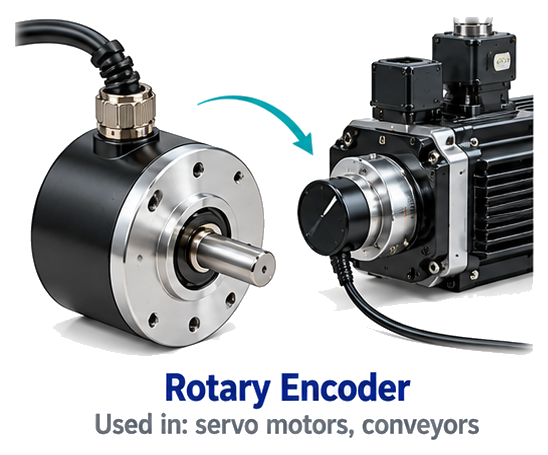
Rotary Encoder
A rotary encoder is attached to a shaft and gives digital pulses as the shaft turns. By counting the pulses, the controller knows the angle, the direction and the speed. Incremental encoders give pulses, while absolute encoders give a unique code for every angle. It is used on servo motors and conveyors.
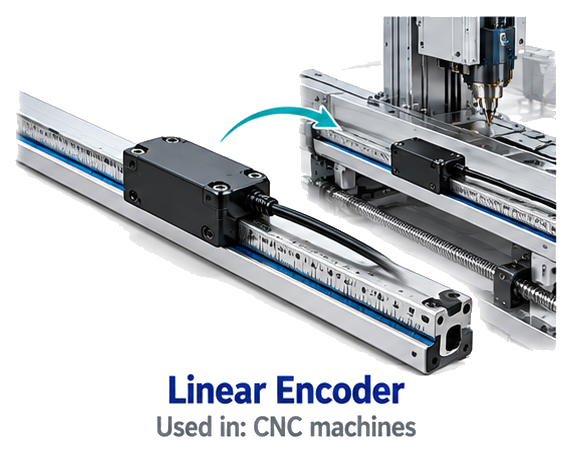
Linear Encoder
A linear encoder reads a very fine scale along a straight path and gives pulses for each small step of movement. The controller counts these pulses to know the exact position, down to micrometres. It is used on CNC machine tools and other equipment where accurate positioning is needed.
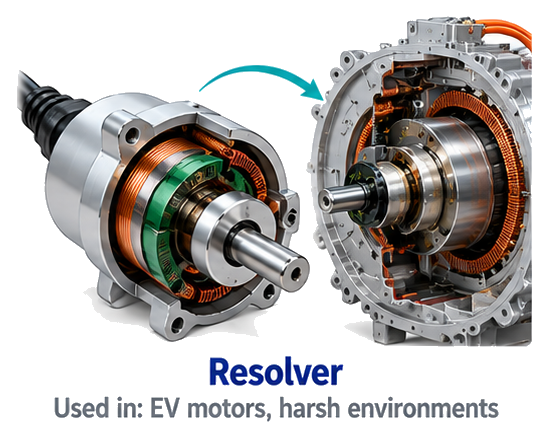
Resolver
A resolver looks like a small motor, with a rotor winding and two stator windings. As the rotor turns, it gives two analogue voltages whose values depend on the shaft angle. It has no electronics inside, so it works very reliably in heat, vibration and dirt. It is widely used in EV motors.
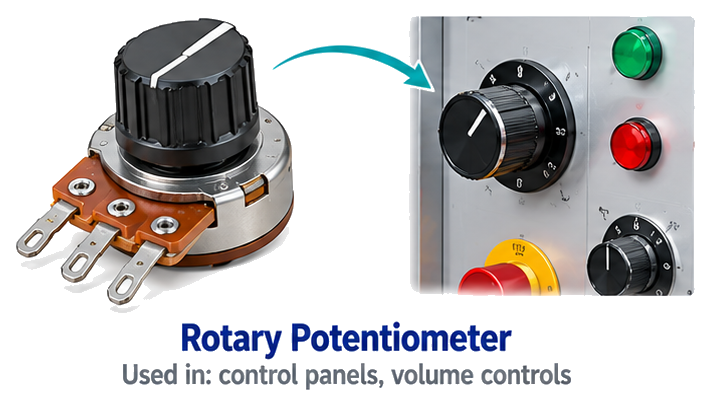
Rotary Potentiometer
A rotary potentiometer has a resistive track and a wiper that turns with a shaft or knob. The output voltage changes with the angle of the shaft. It is a simple, cheap way to measure angle and is used in control panels, volume controls and simple feedback, but it wears out with use.
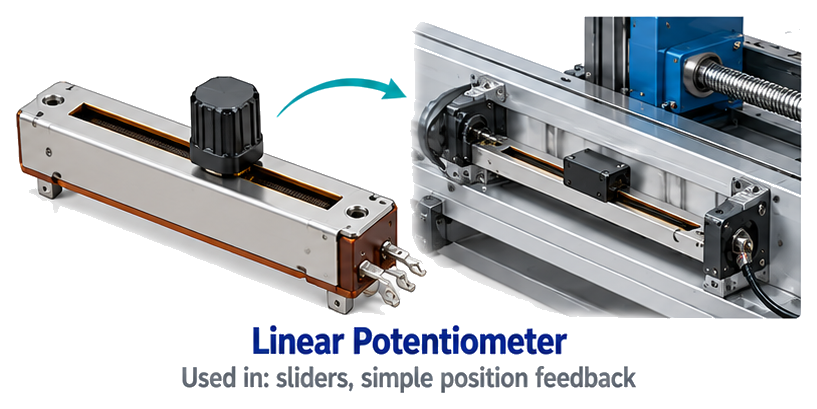
Linear Potentiometer
A linear potentiometer (slide type) gives a voltage that depends on the position of its slider along a resistive track. The slider is moved by the part whose position needs to be known. It is simple and cheap and used for sliders and basic position feedback, but it wears over time.
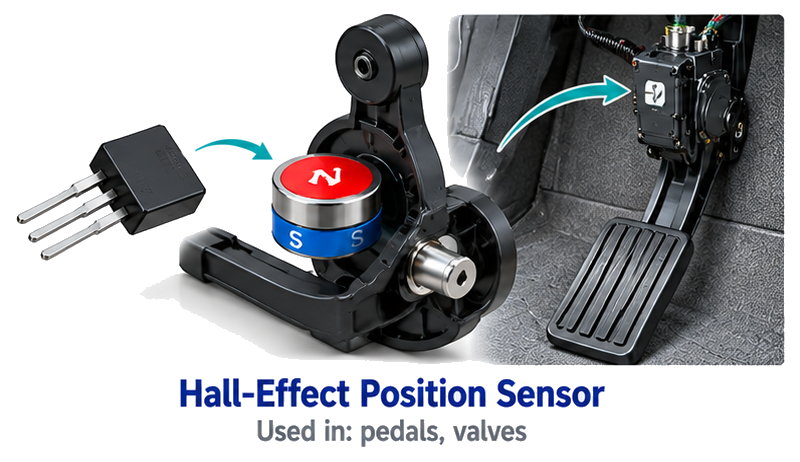
Hall-Effect Position Sensor
A Hall-effect position sensor measures the position or angle of a magnet using a Hall chip. As the magnet moves, the magnetic field at the chip changes and so does the output voltage. It is contactless, so it does not wear out and is used in pedals, valves and throttles.
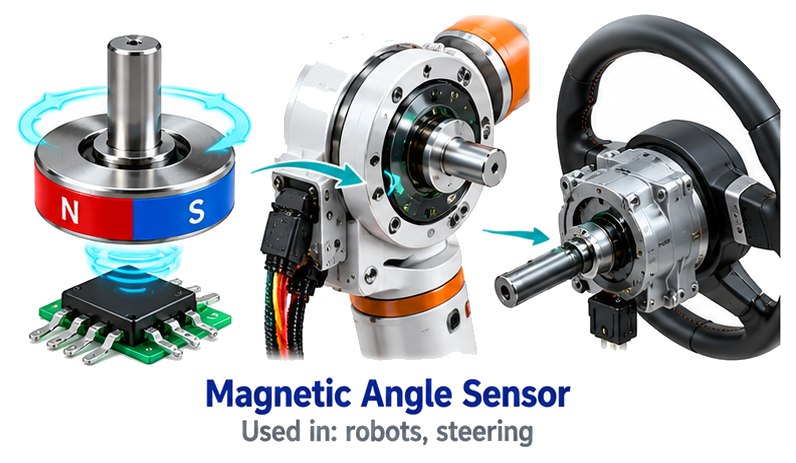
Magnetic Angle Sensor
A magnetic angle sensor reads the angle of a small magnet fixed on a rotating shaft. The sensor chip measures the direction of the magnetic field and gives the angle as an analogue or digital output. It is compact and contactless, so it is used in robots, steering and motor control.
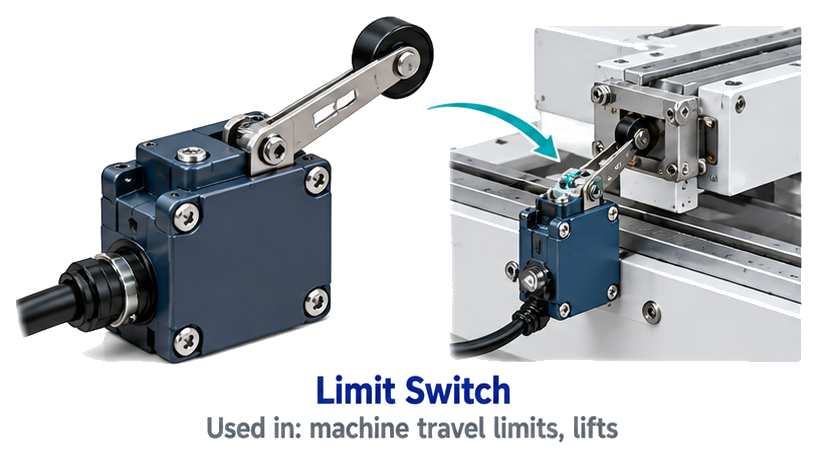
Limit Switch
A limit switch is a mechanical switch with an actuator, such as a lever or plunger. When a moving part touches the actuator, the contacts change state. This tells the machine that the part has reached a limit, so it can stop or reverse. It is simple, strong and widely used for travel limits.
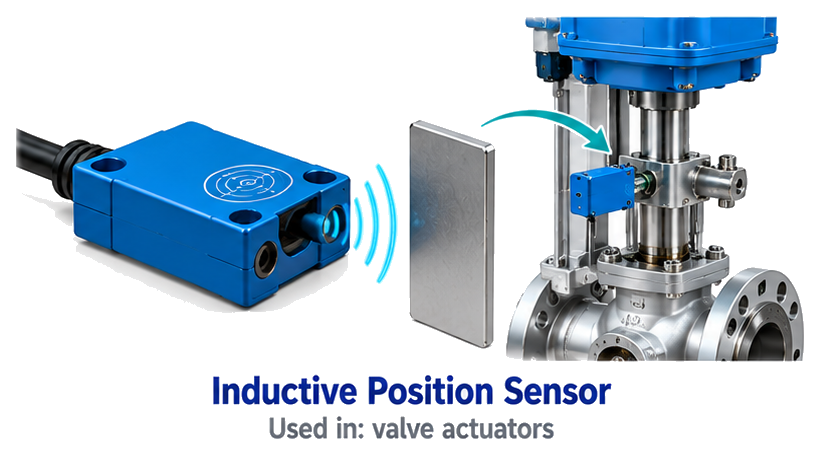
Inductive Position Sensor
An inductive position sensor measures the position of a metal target using the change in a coil's magnetic field. As the target moves, the coil's inductance changes, and the electronics convert it into a position signal. It is non-contact and strong, so it works well in dirty, oily or wet places such as valve actuators.
- Get link
- X
- Other Apps
Comments
Post a Comment