ELECTRICAL MEASUREMENT SENSORS
Electrical sensing looks complicated until you notice it is just three quantities: voltage, current and what you build from them. Keep this page near your panel.
PART 17 OF 25 | 4 MIN READ | BY SUBODH RAJ
Power (DC or resistive AC)
P = V x I
Three-phase real power
P = sqrt(3) x V(line) x I x power factor
Apparent power
S = sqrt(3) x V x I
Shunt voltage
V = I x R (Ohm's law)
CT ratio example
200:5 means 200 A on primary gives 5 A on secondary
Which current sensor
| Sensor | AC | DC | Isolated | Notes |
|---|
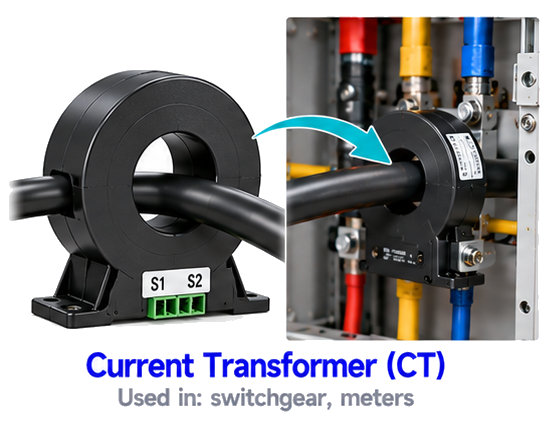
| Current transformer | Yes | No | Yes | Never open the secondary while energised |
| Hall-effect | Yes | Yes | Yes | Used in EV and drive electronics |
| Shunt resistor | Yes | Yes | No | Accurate and cheap, but wastes power as heat |
| Rogowski coil | Yes | No | Yes | Flexible, very large currents |
Safety: Never open the secondary circuit of a CT while the primary carries current. The voltage can become dangerously high. Short the secondary first.
Voltage sensing
A voltage transducer scales a voltage to a safe signal. A potential transformer (PT or VT) steps a high voltage down to something like 110 V for meters and relays. In both cases, isolation protects instruments and people.
A power-quality analyser records sags, surges, harmonics and imbalance. Typical limits: voltage within about plus or minus 10 percent of nominal, and total harmonic distortion kept under limits set by your standard.
Quick selection rules
- Metering and protection on the AC mains: CT and PT.
- Motor drives and inverters: Hall or shunt with fast response.
- Welders and busbars: Rogowski coil.
- Billing: a certified energy meter.
The 10 sensors in this part
Each card below shows the sensor in use, what it is and how it works, and where you will find it.
SENSOR 1 OF 10
Current Transformer (CT)
A current transformer (CT) reduces a large AC current to a small, safe value, such as 1 A or 5 A. It has a primary winding, often just the conductor, and a secondary winding. It keeps the measuring instrument safe from high current and is used in switchgear and energy meters.
USED IN
switchgearmeters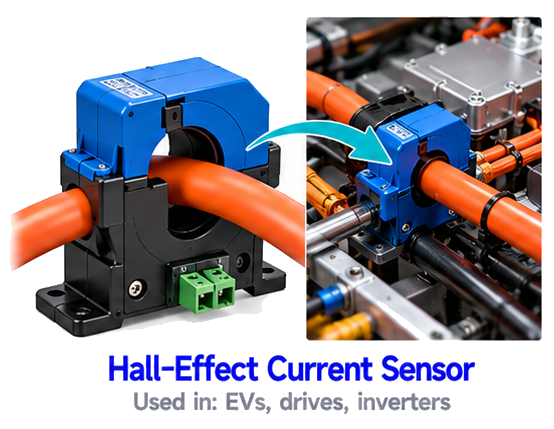
SENSOR 2 OF 10
Hall-Effect Current Sensor
A Hall-effect current sensor measures current by sensing the magnetic field around a conductor. A Hall chip in a gap of a magnetic core gives a voltage that follows the field. It measures both AC and DC and isolates the circuit, so it is used in EVs, drives and inverters.
USED IN
EVsdrivesinverters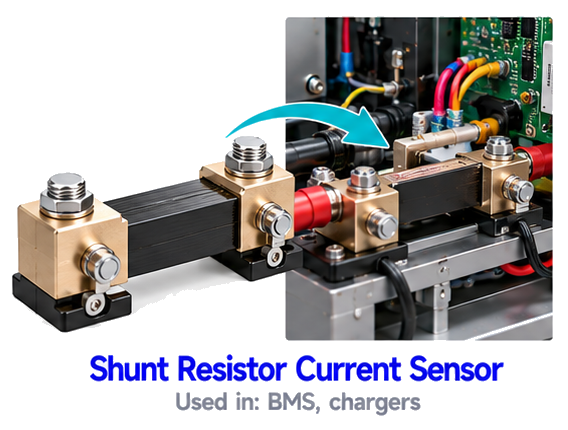
SENSOR 3 OF 10
Shunt Resistor Current Sensor
A shunt resistor current sensor uses a very small, accurate resistor in the current path. The current causes a small voltage across it (Ohm's law), and this is measured. It is simple and cheap and works for AC and DC, but it is not isolated and it wastes a little power as heat.
USED IN
BMSchargers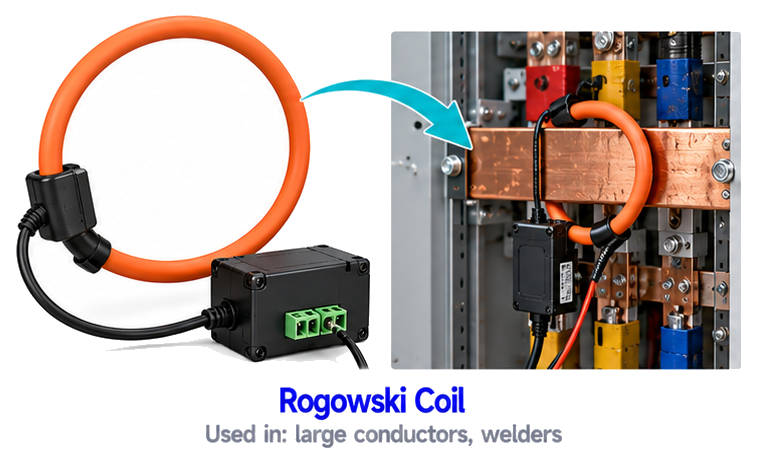
SENSOR 4 OF 10
Rogowski Coil
A Rogowski coil is a flexible, open-ended coil that is wrapped around a conductor. It gives a voltage that is proportional to how fast the current changes, and an integrator converts it to current. It is light, cannot saturate and can measure very large AC currents, such as those of welders.
USED IN
large conductorswelders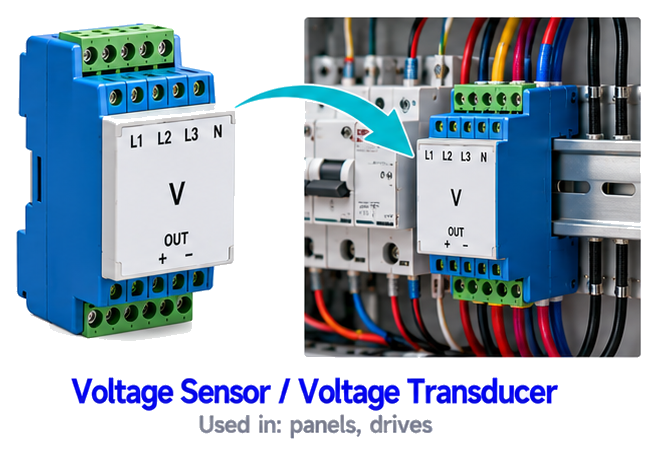
SENSOR 5 OF 10
Voltage Sensor / Voltage Transducer
A voltage sensor (voltage transducer) measures a voltage and gives a smaller, isolated signal such as 0-10 V or 4-20 mA. It keeps the control electronics safe from the high voltage. It is used in panels, drives and monitoring systems.
USED IN
panelsdrives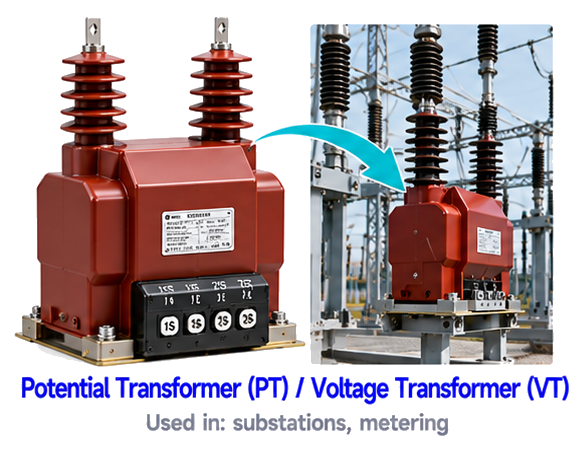
SENSOR 6 OF 10
Potential Transformer (PT) / Voltage Transformer (VT)
A potential transformer (PT), also called a voltage transformer (VT), reduces a high voltage to a safe low voltage, such as 110 V. Meters and protection relays use this low voltage. It also isolates the high voltage from instruments, so it is used in substations and metering.
USED IN
substationsmetering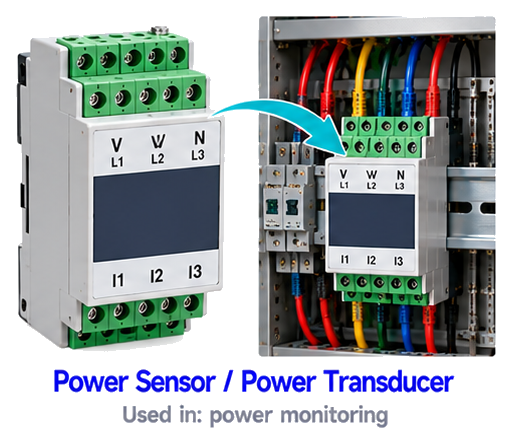
SENSOR 7 OF 10
Power Sensor / Power Transducer
A power sensor (power transducer) measures electric power by combining voltage and current measurements. It gives an output signal, often 4-20 mA, that is proportional to power in watts. It is used for monitoring the load of machines and plants.
USED IN
power monitoring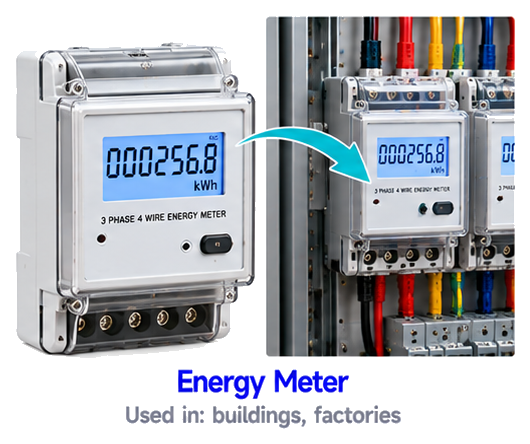
SENSOR 8 OF 10
Energy Meter
An energy meter measures the total electrical energy used over time, in kilowatt-hours (kWh). It continuously measures voltage and current, calculates power and adds it up. It is used for billing and for monitoring energy use in buildings and factories.
USED IN
buildingsfactories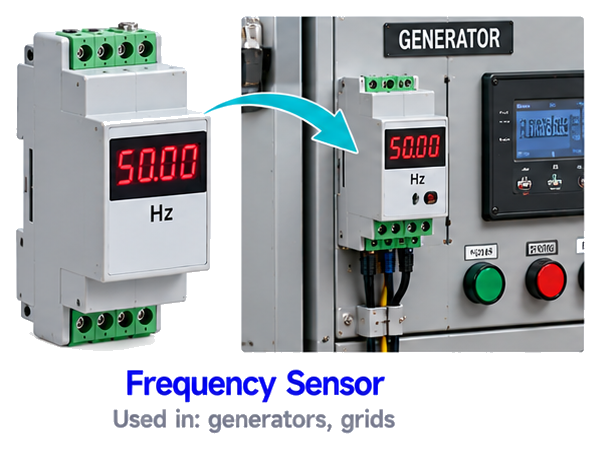
SENSOR 9 OF 10
Frequency Sensor
A frequency sensor measures how many times per second an AC supply changes direction, in hertz (Hz). It is important because machines and generators work correctly only near the correct frequency. It is used for generators, grids and drives.
USED IN
generatorsgrids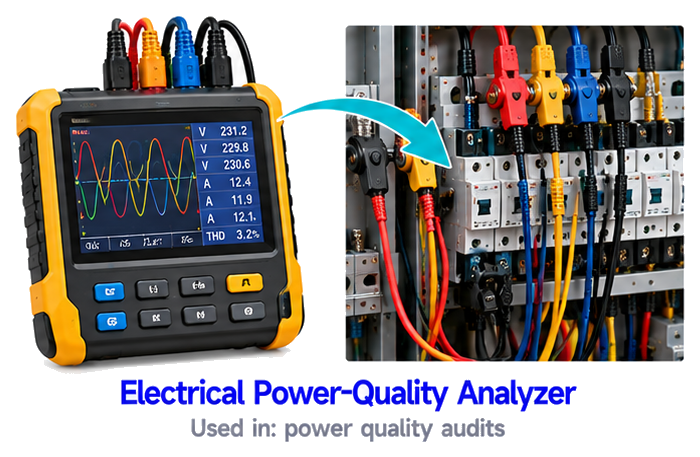
SENSOR 10 OF 10
Electrical Power-Quality Analyzer
An electrical power-quality analyzer records voltage, current, power and problems such as sags, surges, harmonics and unbalance. It shows whether the supply is clean and stable. It is used for power-quality audits and to find the reasons for equipment trouble.
USED IN
power quality auditsWant all 250+ sensors in one place?
The Master Sensor Handbook explains every sensor with its picture, definition and where it is used.
Buy the Master Sensor Handbook | INR 199Tap the button to message us on WhatsApp
Written by Subodh Raj,
EngineerX Academy. Part 17 of 25 in the Industrial Sensors series.
Comments
Post a Comment