LEVEL SENSORS
Level sensors fail when they are chosen by habit. Answer these six questions about your tank first. The answers usually point to one or two suitable technologies.
PART 9 OF 25 | 5 MIN READ | BY SUBODH RAJ
1. Do you need a switch or a continuous reading?
A switch only tells you high or low. Float, vibrating-fork, conductive and optical sensors do this well. If you need to know how full the tank is, choose a continuous type such as radar, ultrasonic, hydrostatic or guided-wave.
2. What is the material?
Clean liquid, foam, sludge, powder and granules behave differently. Vibrating-fork sensors work in both liquids and solids. Conductive probes work only in conductive liquids. Capacitive probes can handle many materials but need calibration.
3. Is the tank open or closed?
Ultrasonic sensors are good in open tanks and wells. In closed, pressurised tanks with vapour, radar or differential-pressure sensors are more reliable.
4. Is there foam, steam, dust or turbulence?
Ultrasonic sound weakens in heavy vapour and dust. Radar is unaffected by temperature, pressure and vapour. Guided-wave radar uses a probe, which helps in narrow, turbulent or foamy tanks.
5. Can you put anything inside the tank?
If not, use outside methods: a magnetic level gauge on a side chamber, load cells that weigh the tank, or non-contact radar and ultrasonic from the top.
6. What happens if it fails?
For overfill protection, use a different sensing principle for the safety alarm than for control. A vibrating fork as a high-level switch, plus radar for control, means one fault cannot take out both.
Summary table
| Situation | Good first choice |
|---|
| Water tank, simple on/off | Float switch |
| Sump or well, continuous | Hydrostatic or ultrasonic |
| Chemical tank, closed | Radar |
| Boiler or interface level | Guided-wave radar |
| Silo of powder, high alarm | Vibrating fork |
| Heavy bulk solids | Weighing with load cells |
The 13 sensors in this part
Each card below shows the sensor in use, what it is and how it works, and where you will find it.
SENSOR 1 OF 13
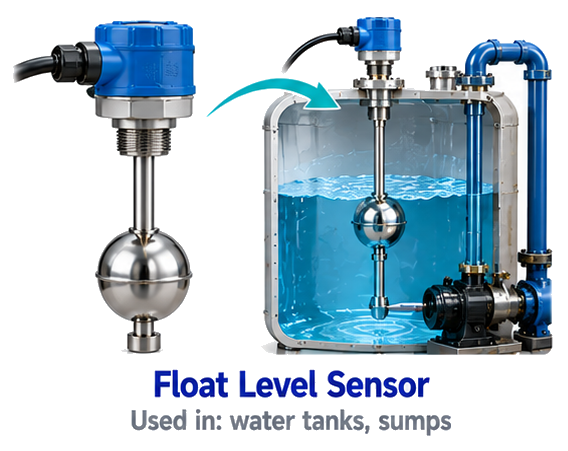
Float Level Sensor
A float level sensor has a floating ball or body that moves up and down with the liquid surface. The float moves a magnet or a mechanical arm, which operates a switch or gives a signal. It is simple and reliable for level switching and indication in water tanks and sumps.
USED IN
water tankssumps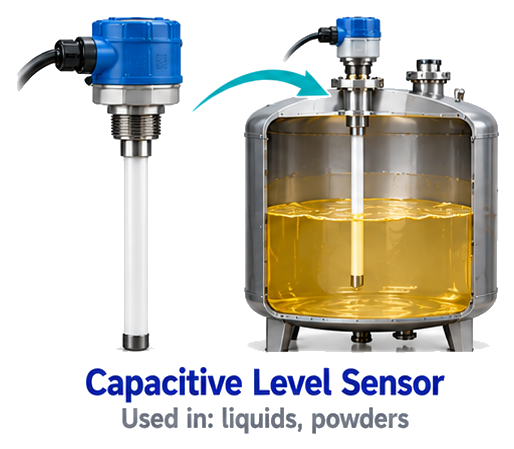
SENSOR 2 OF 13
Capacitive Level Sensor
A capacitive level sensor has a probe that acts as one plate of a capacitor, and the tank wall or a second probe acts as the other. As the liquid or powder covers more of the probe, the capacitance increases. The electronics convert this into a level. It works with many materials.
USED IN
liquidspowders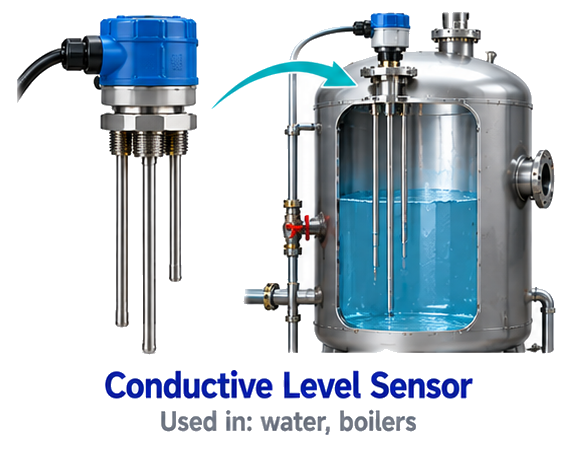
SENSOR 3 OF 13
Conductive Level Sensor
A conductive level sensor uses two or more metal probes of different lengths. When the liquid touches a probe, it completes an electrical circuit between probes, and the sensor detects the level. It works only with conductive liquids such as water, and is low cost and simple for level control.
USED IN
waterboilers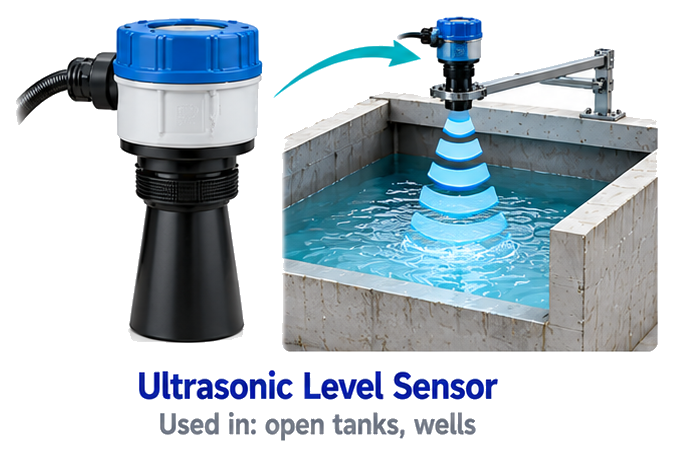
SENSOR 4 OF 13
Ultrasonic Level Sensor
An ultrasonic level sensor is fitted at the top of a tank and sends a sound pulse downward. The pulse reflects from the surface, and the time for the echo gives the distance to the surface. From this the level is calculated. It is non-contact and suits open tanks and wells.
USED IN
open tankswells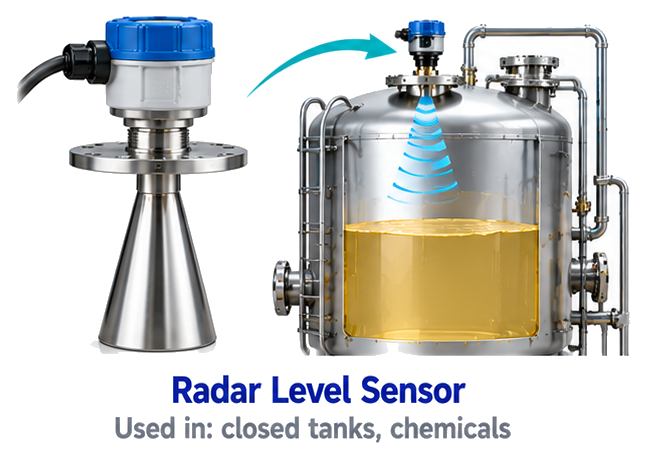
SENSOR 5 OF 13
Radar Level Sensor
A radar level sensor sends microwave pulses down to the surface and measures the time for the reflected signal. It is not affected by temperature, pressure, vapour or dust, so it is very reliable. It works in closed tanks and with chemicals and gives accurate level without any contact.
USED IN
closed tankschemicals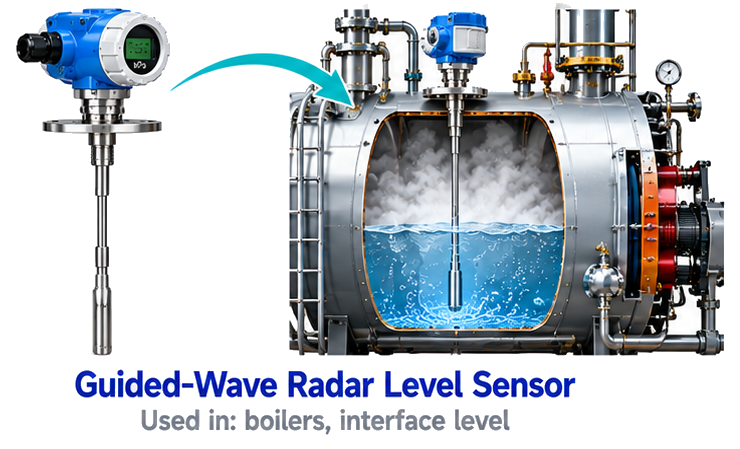
SENSOR 6 OF 13
Guided-Wave Radar Level Sensor
A guided-wave radar level sensor sends radar pulses along a rod or cable dipped in the tank. The pulses travel down the probe and reflect from the liquid surface, and the time gives the level. Since the pulses are guided, it works well in narrow tanks, boilers and for interface level.
USED IN
boilersinterface level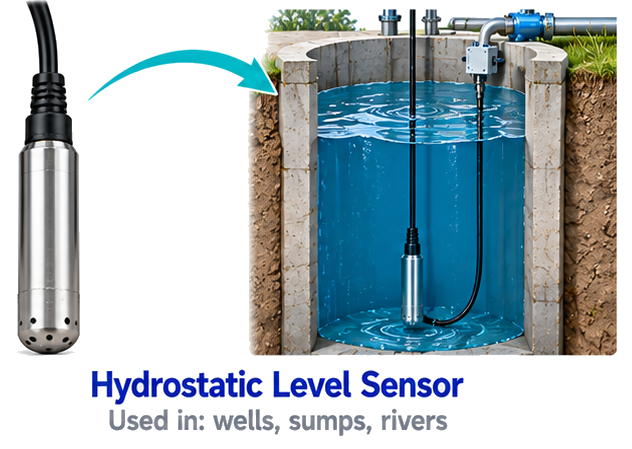
SENSOR 7 OF 13
Hydrostatic Level Sensor
A hydrostatic level sensor is placed at the bottom of a liquid, in a well or tank. It measures the pressure of the liquid column above it. Because the pressure is proportional to the height and the density, the level can be calculated. It is simple and widely used in wells, sumps and rivers.
USED IN
wellssumpsrivers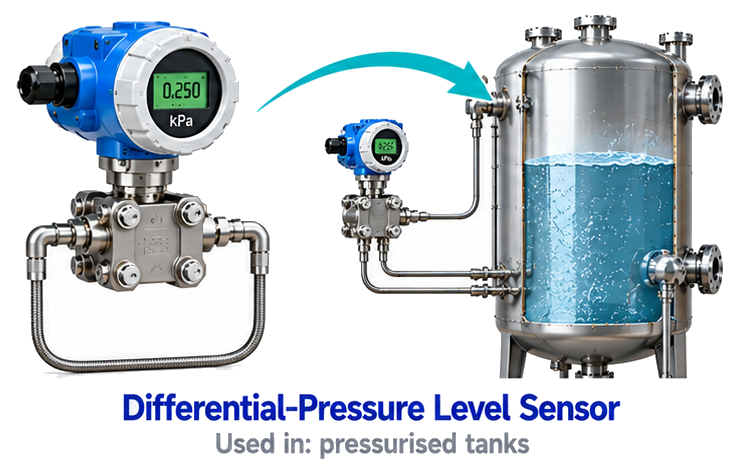
SENSOR 8 OF 13
Differential-Pressure Level Sensor
A differential-pressure level sensor measures the pressure difference between the bottom and the top of a closed tank. The difference is caused by the weight of the liquid, so it is proportional to the level, even if the tank is under pressure. It is a common solution for pressurised tanks.
USED IN
pressurised tanks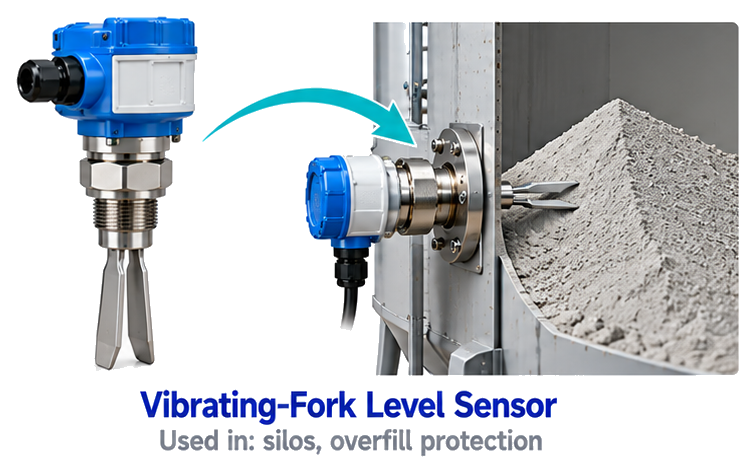
SENSOR 9 OF 13
Vibrating-Fork Level Sensor
A vibrating-fork level sensor has a fork that vibrates at its natural frequency. When the fork is covered by liquid or solid, the vibration changes, and the sensor switches. It works with liquids, powders and granules, is not affected by most material properties, and is used for high or low level alarms.
USED IN
silosoverfill protection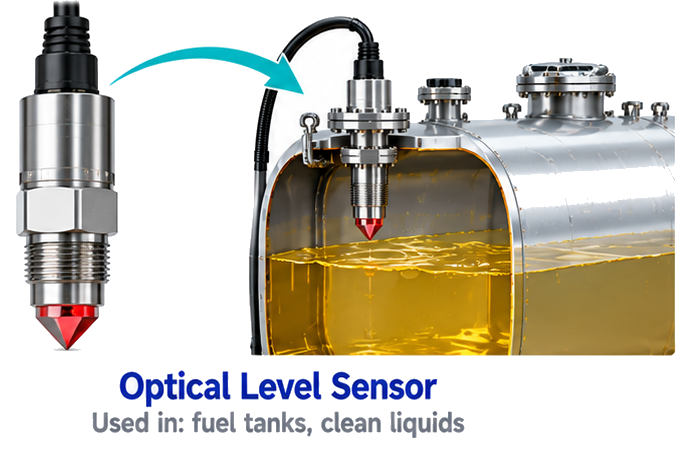
SENSOR 10 OF 13
Optical Level Sensor
An optical level sensor has a prism or a light path at its tip. In air, the light reflects back to the receiver, but when the tip is dipped in liquid, the light escapes and the signal changes. It gives a clear on/off level signal for clean liquids and is compact.
USED IN
fuel tanksclean liquids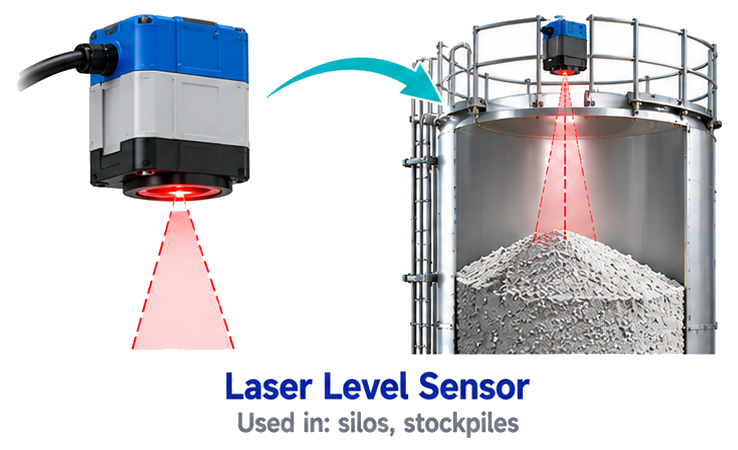
SENSOR 11 OF 13
Laser Level Sensor
A laser level sensor sends a narrow laser beam to the material surface and measures the distance by time or phase of the returning light. The narrow beam can pass through dusty air and a small opening, so it is used for solids such as grain in silos and for stockpiles.
USED IN
silosstockpiles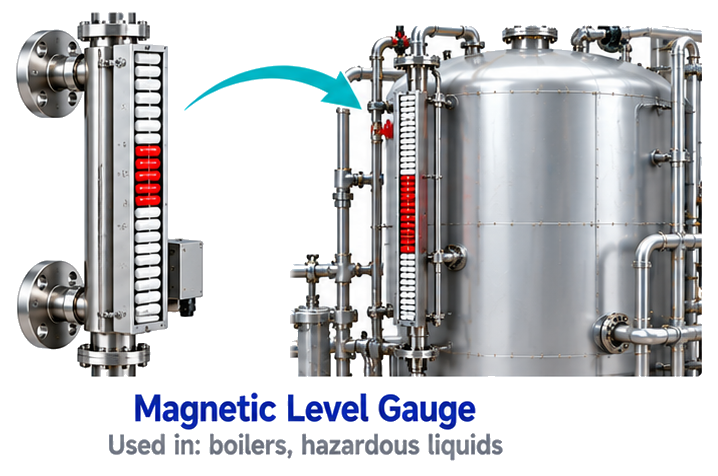
SENSOR 12 OF 13
Magnetic Level Gauge
A magnetic level gauge has a chamber attached to the side of the tank, with a magnetic float inside. The float's magnet turns small flags on an indicator outside, so the level can be seen clearly. It has no leak path and is very reliable for boilers and dangerous liquids.
USED IN
boilershazardous liquids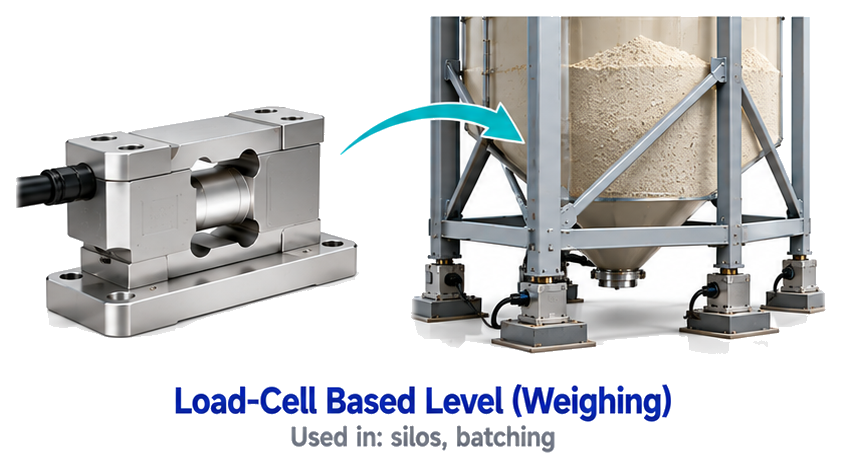
SENSOR 13 OF 13
Load-Cell Based Level (Weighing)
Load-cell based level measurement finds the level by weighing the tank. Load cells under the tank legs measure the total weight, and the weight of the empty tank is subtracted. The remaining weight shows the amount of material. It is useful for silos, hoppers and batching.
USED IN
silosbatchingWant all 250+ sensors in one place?
The Master Sensor Handbook explains every sensor with its picture, definition and where it is used.
Buy the Master Sensor Handbook | INR 199Tap the button to message us on WhatsApp
Written by Subodh Raj,
EngineerX Academy. Part 9 of 25 in the Industrial Sensors series.
Comments
Post a Comment