FORCE, TOUCH & TACTILE SENSORS
Robots see well and move precisely, yet they still struggle to pick up a ripe tomato or turn a key. The missing piece is touch. Tactile sensors are the area where robotics is changing most quickly.
PART 23 OF 25 | 4 MIN READ | BY SUBODH RAJ
A vision system tells a robot where an object is. Touch tells it whether the object slipped, how hard it is squeezed, and how rough or soft it is. That information arrives in milliseconds, much faster than a camera can process an image.
Simple touch: switches and films
Resistive touch sensors press two conductive layers together. Capacitive sensors notice the electrical field of a finger. Force-sensitive resistors reduce their resistance as force rises. All are thin and cheap but not very accurate, which makes them good for presence and rough force.
Measuring force properly
Strain-gauge tactile sensors and piezoelectric sensors give a measurable force. Piezo responds fast, so it detects slip and vibration, but it cannot hold a steady reading. A 3D force/torque sensor at a robot wrist measures push in three directions plus twisting.
Optical tactile sensors put a camera behind a soft gel. When the gel is pressed, the camera sees the deformation and software computes shape and force, like a very detailed fingerprint. Magnetic tactile sensors place magnets inside soft material and measure how they move.
Electronic skin
E-skin is a flexible layer of many sensors that can cover curved surfaces, such as robot hands or prosthetic limbs. The challenge is not just sensing but wiring thousands of points and processing the data.
The practical limits today
- Durability: soft sensors wear faster than rigid ones.
- Calibration: each sensing point drifts differently.
- Data: a dense array produces a lot of values that need fast processing.
In a gripper, a force sensor already makes a difference. It lets one hand handle both an egg and a steel part, with the grip set by feedback rather than guesswork.
The 11 sensors in this part
Each card below shows the sensor in use, what it is and how it works, and where you will find it.
SENSOR 1 OF 11
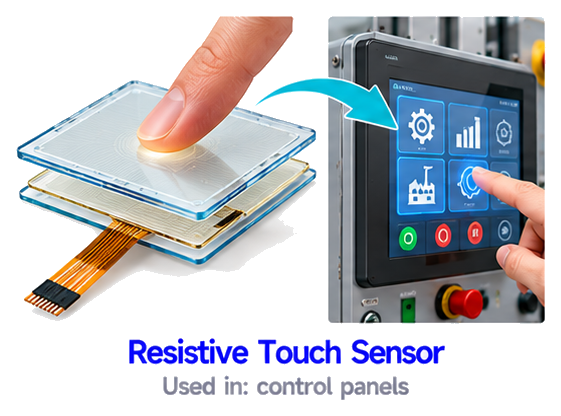
Resistive Touch Sensor
A resistive touch sensor has two flexible conductive layers separated by a small gap. When pressed, the layers touch and the point of contact changes the resistance. It works with a finger, glove or stylus. It is low cost and is used in control panels.
USED IN
control panels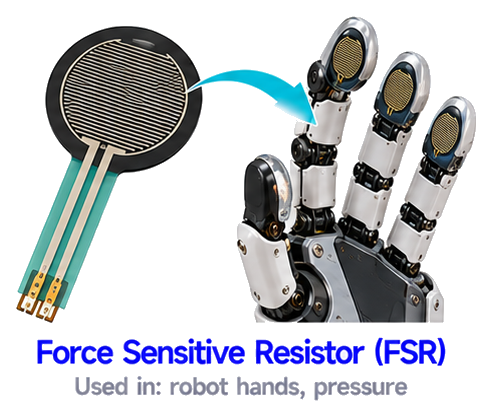
SENSOR 2 OF 11
Force Sensitive Resistor (FSR)
A force-sensitive resistor (FSR) is a thin film whose resistance decreases when force or pressure is applied. It is thin, flexible and low cost, but it is not very accurate. It is used in robot hands, touch pads and presence detection.
USED IN
robot handspressure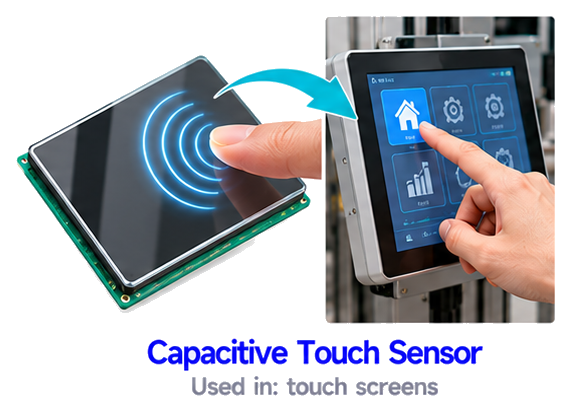
SENSOR 3 OF 11
Capacitive Touch Sensor
A capacitive touch sensor detects a finger because the human body changes the electric field of the sensor and its capacitance. It needs only a light touch and has no moving parts. It is used in touch screens, buttons and control panels.
USED IN
touch screens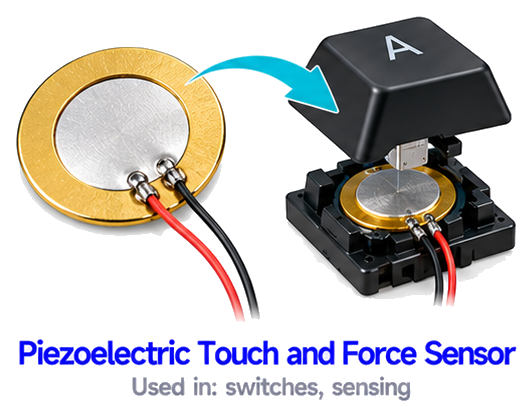
SENSOR 4 OF 11
Piezoelectric Touch and Force Sensor
A piezoelectric touch and force sensor uses a piezoelectric material that produces a voltage when pressed. It responds very fast to touch, tap and vibration. It is used in switches, buttons and sensing of fast force changes.
USED IN
switchessensing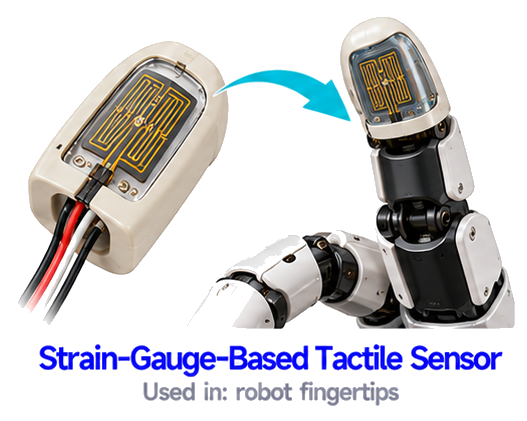
SENSOR 5 OF 11
Strain-Gauge-Based Tactile Sensor
A strain-gauge-based tactile sensor has strain gauges on a small flexible structure. When touched, the structure bends and the gauges change their resistance. It gives a good measure of force. It is used on robot fingertips to feel force.
USED IN
robot fingertips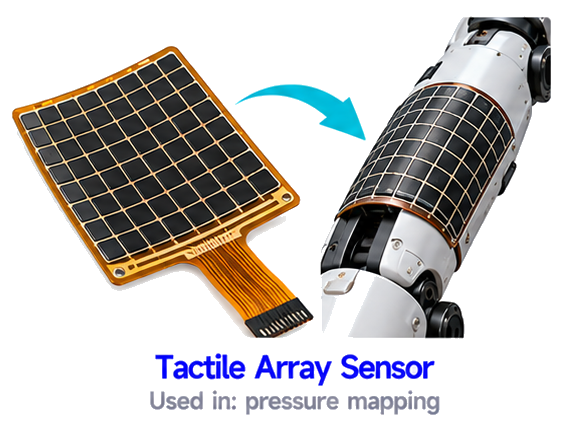
SENSOR 6 OF 11
Tactile Array Sensor
A tactile array sensor is a grid of many small touch or pressure sensors. Each point gives its own reading, so a map of pressure is formed. It shows where and how hard something is pressing, and is used for pressure mapping and grippers.
USED IN
pressure mapping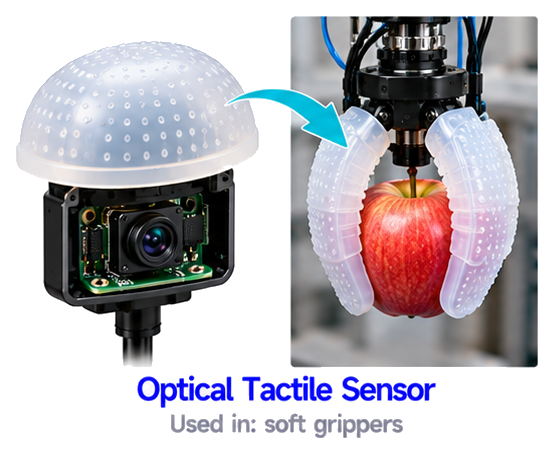
SENSOR 7 OF 11
Optical Tactile Sensor
An optical tactile sensor has a soft surface with a camera or light sensors behind it. When the surface is pressed, the camera sees how it deforms, and software calculates the force and shape. It gives very detailed touch information for soft grippers.
USED IN
soft grippers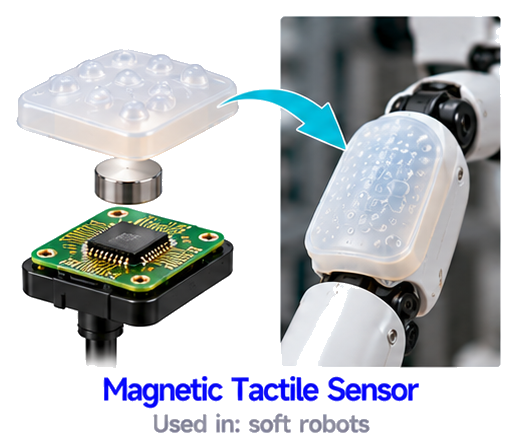
SENSOR 8 OF 11
Magnetic Tactile Sensor
A magnetic tactile sensor has small magnets inside a soft material and magnetic sensors under it. When the material is pressed, the magnets move and the sensors read the change. It is flexible and strong and is used in soft robots.
USED IN
soft robots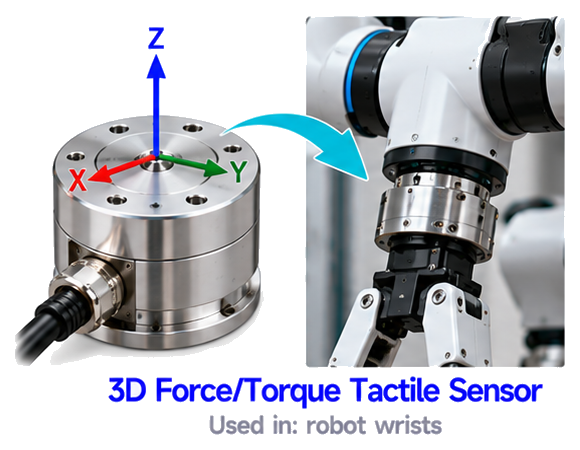
SENSOR 9 OF 11
3D Force/Torque Tactile Sensor
A 3D force/torque tactile sensor measures forces in three directions and the twisting moments at the same time. It is placed between a robot arm and its tool, or in a fingertip. It lets the robot feel how hard it pushes in every direction.
USED IN
robot wrists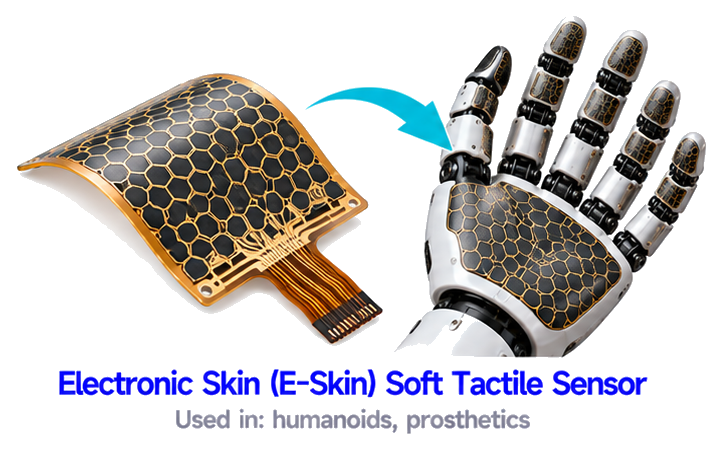
SENSOR 10 OF 11
Electronic Skin (E-Skin) Soft Tactile Sensor
An electronic skin (e-skin) is a thin, soft and stretchable layer of sensors that can feel pressure, touch and sometimes temperature, like human skin. It can cover curved surfaces. It is used on humanoid robots and prosthetic limbs.
USED IN
humanoidsprosthetics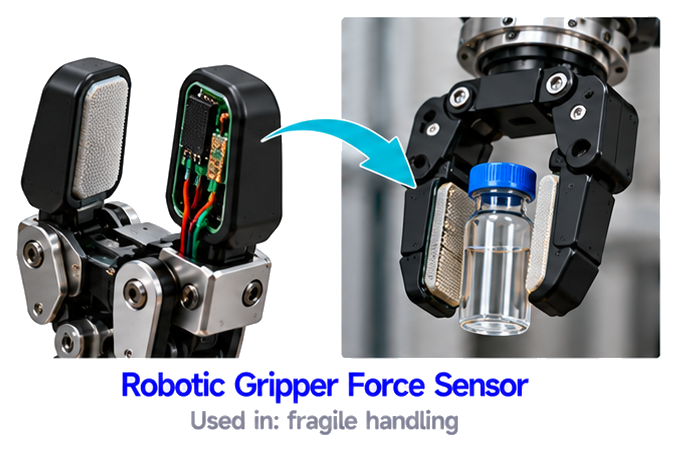
SENSOR 11 OF 11
Robotic Gripper Force Sensor
A robotic gripper force sensor measures how hard the gripper fingers are squeezing an object. The robot uses this to hold the object firmly without crushing it. It is important for handling fragile items such as eggs, glass and electronic parts.
USED IN
fragile handlingWant all 250+ sensors in one place?
The Master Sensor Handbook explains every sensor with its picture, definition and where it is used.
Buy the Master Sensor Handbook | INR 199Tap the button to message us on WhatsApp
Written by Subodh Raj,
EngineerX Academy. Part 23 of 25 in the Industrial Sensors series.
Comments
Post a Comment