MAGNETIC FIELD SENSORS
Magnetic sensing is one of the oldest ideas in engineering, and still one of the fastest-changing. Each step in this story gave sensors more sensitivity in less space.
PART 18 OF 25 | 4 MIN READ | BY SUBODH RAJ
Before electronics: the compass
A floating magnetised needle was the first magnetic sensor. It could only point north, but it changed navigation for centuries.
1830s: induction
Faraday showed that a changing magnetic field induces voltage in a coil. Search coils and inductive pickups still use exactly this principle. They need no power, and they sense changing fields such as a passing gear tooth.
Edwin Hall found that a current-carrying conductor gives a sideways voltage in a magnetic field. It took until semiconductors became common before Hall chips appeared. Now they are in motors, pedals and current sensors, because they are cheap and have no moving parts.
Early 20th century: the reed switch and fluxgate
The reed switch sealed two thin contacts in glass so a magnet could close them. The fluxgate magnetometer used a saturating core to measure weak fields very accurately, which made it useful in geology and navigation.
1850s onward: magnetoresistance, and AMR sensors in the late 20th century
Resistance in some magnetic metals changes with field direction. Anisotropic magnetoresistive (AMR) sensors turned this into compasses and angle sensors with more sensitivity than Hall chips.
1988: giant magnetoresistance
Thin layers of magnetic and non-magnetic metals showed a huge resistance change. GMR heads made modern hard drives possible, and GMR sensors now appear in encoders and current sensors.
2000s: tunnel magnetoresistance
TMR sensors use a thin insulator between magnetic layers. They offer even higher sensitivity with low power, which suits precise sensing and low-power devices.
What it means today
| Sensor | Strength |
|---|
| Reed switch | Zero power, simple |
| Hall | Cheap, robust, wide use |
| AMR | Better sensitivity, angle sensing |
| GMR / TMR | Highest sensitivity, small size |
| Fluxgate | Best for very weak fields |
| Search coil | Changing fields, no power |
The 9 sensors in this part
Each card below shows the sensor in use, what it is and how it works, and where you will find it.
SENSOR 1 OF 9
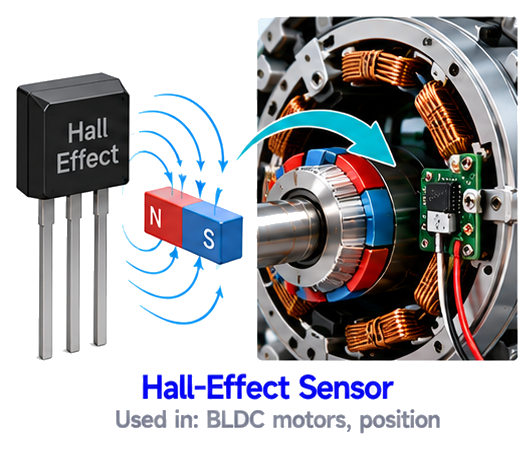
Hall-Effect Sensor
A Hall-effect sensor is a small semiconductor chip that gives a voltage when a magnetic field passes through it. The voltage depends on the strength and direction of the field. It has no moving parts and is used to detect magnets for position, speed and current, for example in BLDC motors.
USED IN
BLDC motorsposition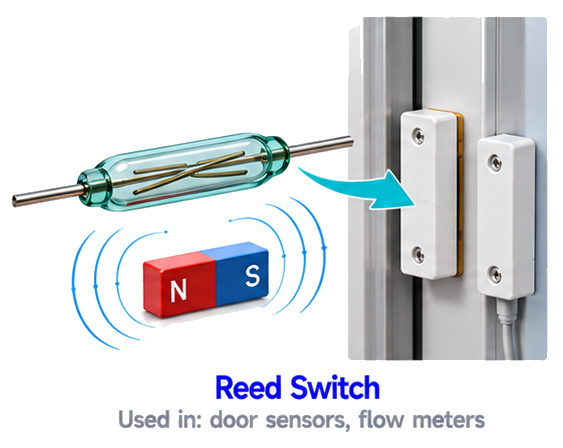
SENSOR 2 OF 9
Reed Switch
A reed switch has two thin metal contacts sealed in a glass tube. A nearby magnet makes the contacts close, and removing the magnet opens them. It needs no power, is very small and works for years, so it is used in door sensors and flow meters.
USED IN
door sensorsflow meters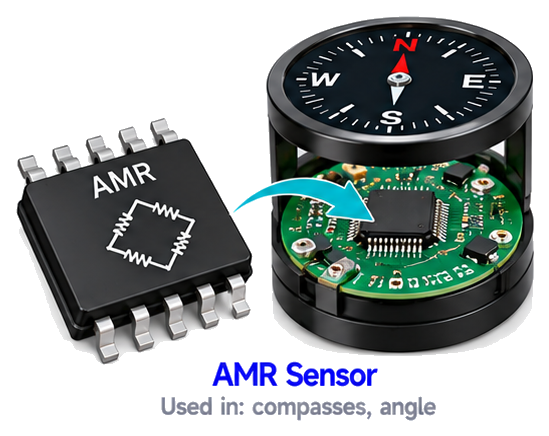
SENSOR 3 OF 9
AMR Sensor
An AMR (Anisotropic Magnetoresistive) sensor is made of a thin magnetic film whose resistance changes slightly with the direction of the magnetic field. It is more sensitive than a Hall sensor. It is used in compasses and for angle and position sensing.
USED IN
compassesangle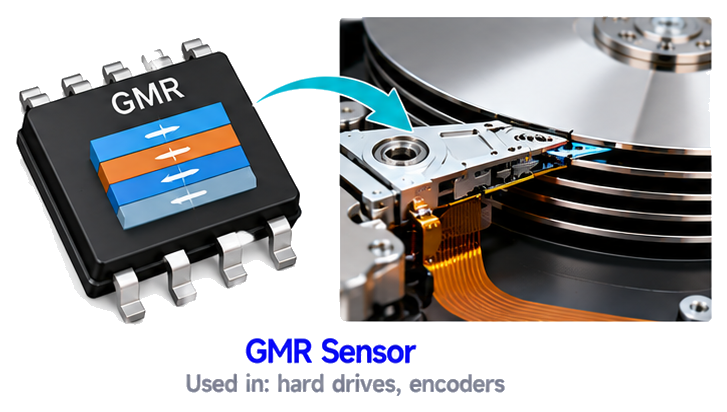
SENSOR 4 OF 9
GMR Sensor
A GMR (Giant Magnetoresistive) sensor has very thin layers of magnetic and non-magnetic metals. Its resistance changes a lot with the magnetic field, so it is very sensitive. It is used in hard-drive heads and in encoders and current sensors.
USED IN
hard drivesencoders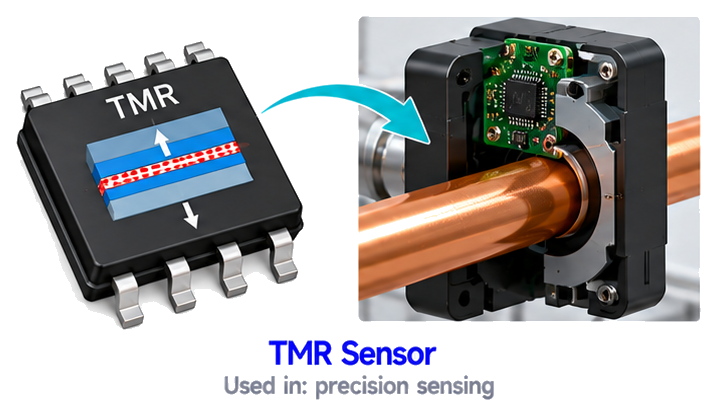
SENSOR 5 OF 9
TMR Sensor
A TMR (Tunnel Magnetoresistive) sensor has two magnetic layers separated by a very thin insulator. Electrons tunnel through it, and the resistance changes greatly with the field. It has very high sensitivity and low power use, so it is used for precise sensing.
USED IN
precision sensing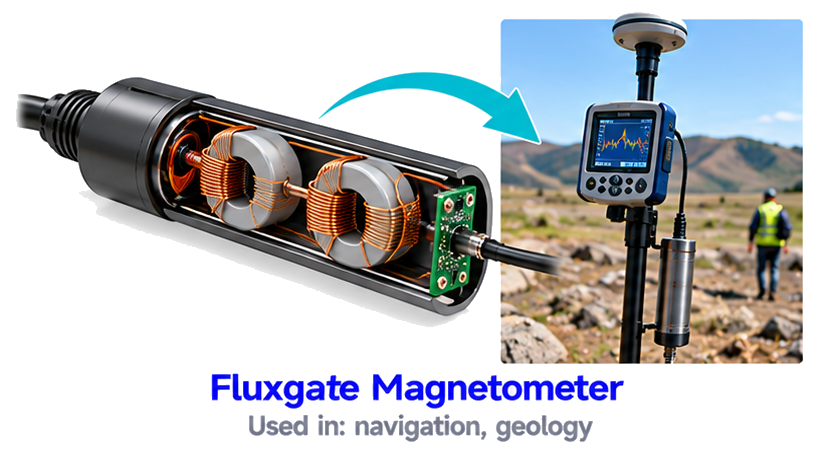
SENSOR 6 OF 9
Fluxgate Magnetometer
A fluxgate magnetometer has a magnetic core that is driven in and out of saturation by a coil. A weak outside magnetic field changes this behaviour, which is measured. It can measure very weak fields, like the Earth's, with high accuracy, so it is used in navigation and geology.
USED IN
navigationgeology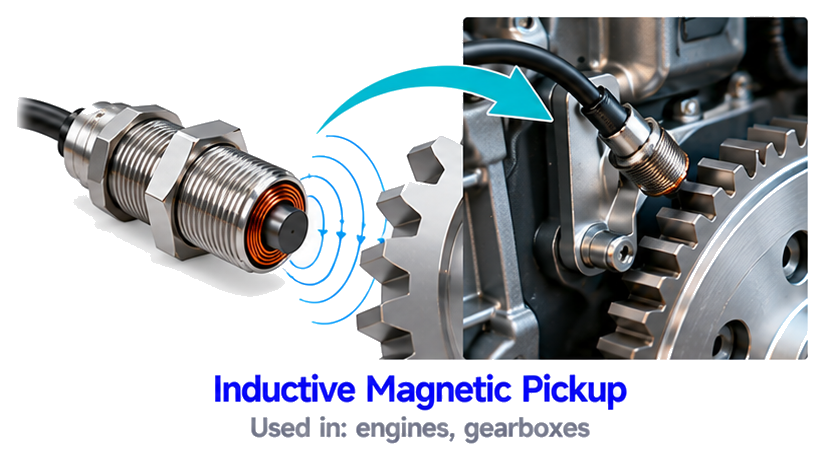
SENSOR 7 OF 9
Inductive Magnetic Pickup
An inductive magnetic pickup is a coil wound around a magnet. When a metal part such as a gear tooth passes by, the magnetic field changes and a voltage is produced in the coil. It needs no power and is rugged, so it is used for speed sensing on engines and gearboxes.
USED IN
enginesgearboxes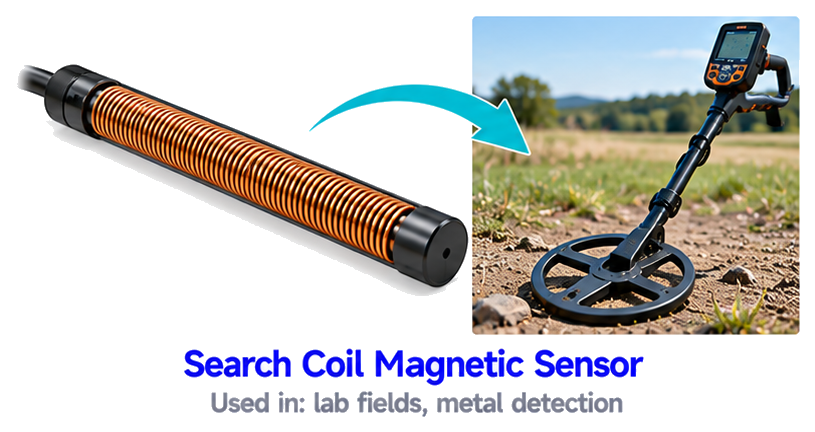
SENSOR 8 OF 9
Search Coil Magnetic Sensor
A search coil magnetic sensor is a coil of many turns of wire. When the magnetic field through it changes, a voltage is made in the coil. It can measure changing fields very well. It is used in labs, metal detectors and field mapping.
USED IN
lab fieldsmetal detection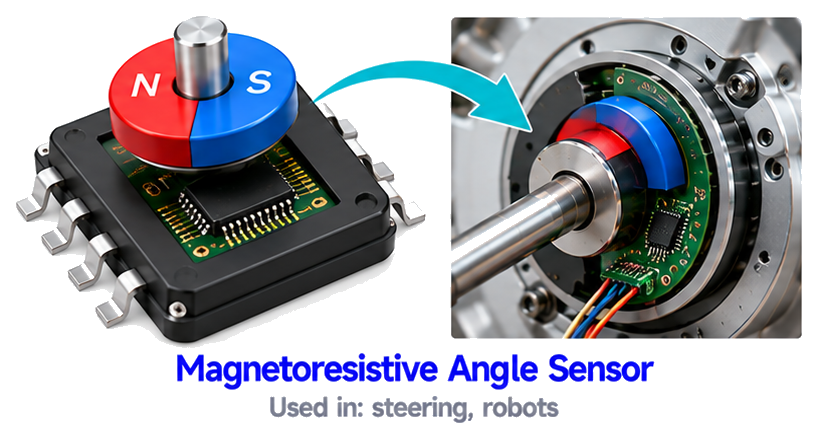
SENSOR 9 OF 9
Magnetoresistive Angle Sensor
A magnetoresistive angle sensor measures the angle of a rotating magnet using magnetoresistive elements. The resistance changes with the field direction, and the electronics give the angle. It is accurate and contactless and is used in steering systems and robots.
USED IN
steeringrobotsWant all 250+ sensors in one place?
The Master Sensor Handbook explains every sensor with its picture, definition and where it is used.
Buy the Master Sensor Handbook | INR 199Tap the button to message us on WhatsApp
Written by Subodh Raj,
EngineerX Academy. Part 18 of 25 in the Industrial Sensors series.
Comments
Post a Comment